Acrylic solid surface is widely used in healthcare facilities, hospitality projects, commercial interiors, laboratories, and residential applications because of its balanced mechanical performance, seamless fabrication capability, and design flexibility.
As a professional acrylic solid surface manufacturer with more than 20 years of fabrication and project experience, ACRION understands that the long-term performance of solid surface materials depends not only on aesthetics, but also on structural stability, impact resistance, fabrication workability, and overall mechanical behavior.
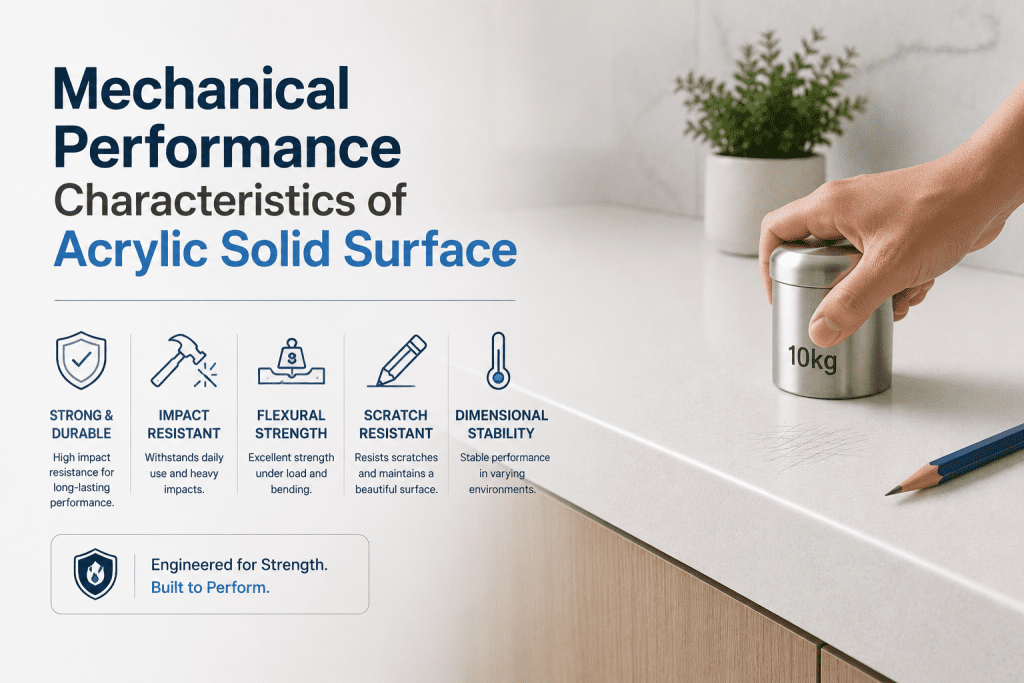
Mechanical properties such as flexural strength, flexural modulus, impact resistance, and thermoforming capability all contribute to the practical performance of acrylic solid surface in commercial and architectural environments.
What Is Flexural Modulus?
Flexural modulus, sometimes referred to as bending modulus or elastic modulus in bending applications, measures the stiffness of a material when subjected to bending forces.
In simple terms, a higher flexural modulus generally means the material is more resistant to bending deformation under load.
For acrylic solid surface materials, flexural modulus is one of several important mechanical indicators used to evaluate structural performance.
Flexural Strength vs Flexural Modulus
Flexural strength and flexural modulus are related but different material properties.
| Property | คำอธิบาย |
|---|---|
| ความแข็งแรงของแรงดัดงอ | Measures how much bending stress the material can withstand before failure |
| โมดูลัสแรงดัดงอ | Measures the stiffness of the material during bending |
| ทนต่อแรงกระแทก | Measures the ability to resist sudden impact forces |
| ความสามารถในการเทอร์โมฟอร์ม | Measures the material’s ability to be shaped under controlled heating conditions |
In practical fabrication and architectural applications, balanced mechanical performance is usually more important than focusing on a single property alone.
Why Mechanical Performance Matters in Solid Surface Applications
In commercial and residential environments, acrylic solid surface materials are often exposed to:
- Daily impact from objects
- Long-span countertop installations
- Fabrication stress during machining
- Thermal forming processes
- Heavy usage in public environments
For this reason, good structural stability and balanced mechanical behavior are essential for long-term performance.
Impact Resistance of Acrylic Solid Surface
Compared with some rigid stone materials, acrylic solid surface generally provides better impact tolerance and lower brittleness.
This helps reduce the risk of sudden cracking or edge chipping during normal use and fabrication processes.
In practical applications such as healthcare worktops, commercial reception desks, laboratory counters, and residential kitchens, impact resistance contributes to improved long-term durability.
Thermoforming Capability and Fabrication Flexibility
One of the major advantages of acrylic solid surface compared with materials such as quartz surface is its thermoforming capability.
Under controlled heating conditions, acrylic solid surface can be shaped into curved and complex architectural forms.
การใช้งานทั่วไปที่ขึ้นรูปด้วยความร้อน ได้แก่:
- แผนกต้อนรับส่วนหน้าโค้ง
- แบ็กสแปลชแบบรวม
- สถานีงานด้านการดูแลสุขภาพ
- เคาน์เตอร์เชิงพาณิชย์ที่กำหนดเอง
- Organic architectural shapes
It is important to understand that thermoforming capability is mainly related to the polymer composition and heat-forming behavior of the material rather than simply having a high flexural modulus.
Comparison Between Acrylic Solid Surface and Quartz Surface
| Property | พื้นผิวแข็งอะคริลิก | พื้นผิวควอตซ์ |
|---|---|---|
| ความสามารถในการเทอร์โมฟอร์ม | ใช่ | เลขที่ |
| การผลิตที่ไร้รอยต่อ | ยอดเยี่ยม | จำกัด |
| ความสามารถในการซ่อมแซม | Renewable surface | More difficult to repair |
| Brittleness | ต่ำกว่า | สูงกว่า |
| ความยืดหยุ่นในการออกแบบ | สูง | ปานกลาง |
This balance between mechanical performance and fabrication flexibility is one of the reasons acrylic solid surface remains highly popular in architectural applications.
Factors Affecting Mechanical Performance
The mechanical performance of acrylic solid surface can vary depending on several technical factors.
- สูตรเรซิน
- ATH filler ratio
- Manufacturing quality
- ความหนาของแผ่น
- Fabrication methods
- Support structure design
- Installation quality
For this reason, professional fabrication and proper installation are essential for achieving long-term structural stability.
Applications Requiring Good Mechanical Stability
Applications where balanced mechanical performance is particularly important include:
- สภาพแวดล้อมด้านการดูแลสุขภาพ
- พื้นที่ต้อนรับเชิงพาณิชย์
- ท็อปครัวในห้องปฏิบัติการ
- เคาน์เตอร์ต้อนรับ
- ระบบการแสดงผลร้านค้าปลีก
- ห้องครัวและห้องน้ำที่อยู่อาศัย
In these environments, the combination of structural stability, seamless fabrication, and repairability contributes to long-term material performance.
บทสรุป
Acrylic solid surface is valued not simply for a single mechanical property, but for its balanced combination of flexural strength, structural stability, impact resistance, thermoforming capability, and fabrication flexibility.
Compared with many traditional surface materials, acrylic solid surface provides an excellent balance between mechanical performance, design freedom, seamless fabrication, and long-term maintainability.
At ACRION, we continue to develop acrylic solid surface solutions engineered for architectural fabrication, commercial durability, and advanced design applications worldwide.