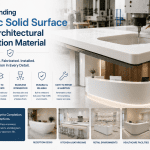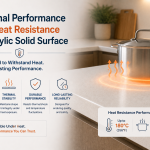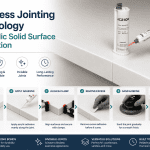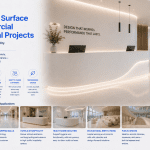
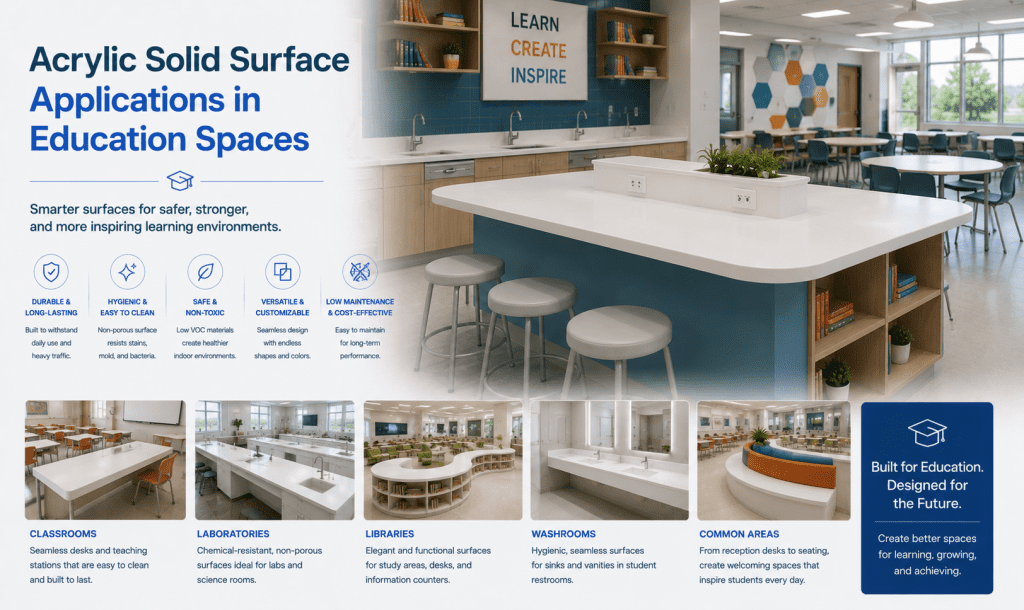
Modern educational facilities increasingly require interior materials that combine durability, hygienic performance, seamless fabrication, and long-term maintenance efficiency. Acrylic solid surface has become widely used in education spaces because of its non-porous structure, fabrication flexibility, and suitability for high-traffic institutional environments.
From laboratories and wash stations to library service counters and collaborative learning furniture, acrylic solid surface supports a wide range of educational interior applications that require both functional performance and architectural consistency.
Why Education Spaces Require Durable Surface Materials
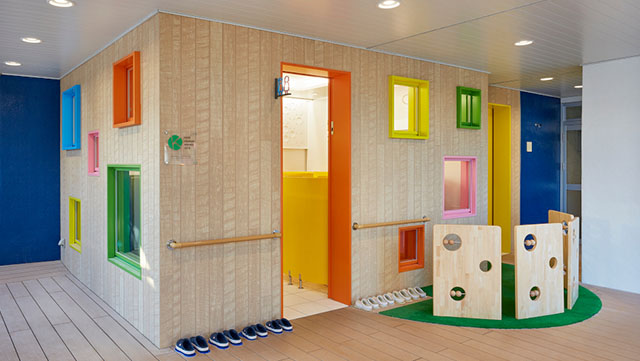
Educational facilities experience continuous daily use from students, faculty members, staff, and visitors. Interior surfaces in these environments must withstand frequent cleaning, long-term wear, impact exposure, and high circulation traffic.
Acrylic solid surface provides a durable and renewable surface solution suitable for many institutional interior environments where long-term maintenance efficiency is an important consideration.
Laboratory and Wash Station Applications
Science laboratories, wash stations, and educational healthcare facilities commonly use acrylic solid surface for worktops, integrated sinks, and hygienic counter systems.
Its non-porous surface structure and seamless fabrication capability help simplify routine cleaning procedures while reducing moisture-prone joints and visible surface transitions.
Integrated sink fabrication and coved backsplash systems are also commonly used in laboratory and wash area environments to improve maintenance efficiency and visual continuity.
Library, Reception, and Service Counters
Educational buildings often require reception desks, circulation counters, information stations, and library service areas that support continuous daily interaction.
Acrylic solid surface supports seamless counter fabrication, curved edge detailing, and customized institutional counter systems for modern educational facilities.
Large continuous countertop surfaces help maintain cleaner architectural lines while supporting lower-maintenance institutional interiors.
Collaborative Learning Furniture and Integrated Workspaces
Modern educational spaces increasingly emphasize collaborative learning environments, multifunctional interiors, and integrated student workspaces.
Acrylic solid surface can be fabricated into customized tables, integrated seating systems, collaborative worktops, and modular educational furniture that support flexible learning layouts.
Its fabrication flexibility also allows curved geometry and softer edge detailing suitable for contemporary educational interior design.
High-Traffic Institutional Interior Applications
Educational facilities are considered high-traffic institutional environments where durability and maintenance efficiency are essential for long-term operation.
Acrylic solid surface is commonly used for:
- Student wash stations
- Cafeteria counters
- Teacher workspaces
- Library service desks
- Administrative counters
- Collaborative learning tables
- Laboratory worktops
- Educational reception areas
Its renewable surface capability also helps extend product lifecycle in institutional environments with continuous daily use.
Seamless Fabrication and Safety-Oriented Design
Seamless fabrication is one of the major advantages of acrylic solid surface in educational environments. Continuous surface systems help reduce visible joints and create cleaner architectural transitions across institutional interiors.
Rounded edges, curved corners, and softer geometry can also be incorporated into educational furniture and countertop systems to support safer high-traffic environments.
Why Designers and Fabricators Choose Acrylic Solid Surface for Educational Facilities
Compared with many traditional institutional surface materials, acrylic solid surface offers greater fabrication flexibility for customized educational interior projects.
The material can be seamlessly joined, CNC processed, thermoformed, integrated with sinks, and fabricated into customized institutional furniture systems.
This flexibility helps architects, designers, and fabricators create cleaner educational environments with stronger visual consistency and simplified maintenance requirements.
Frequently Asked Questions
Why is acrylic solid surface suitable for education spaces?
Acrylic solid surface offers durability, seamless fabrication, hygienic performance, and renewable surface capability suitable for high-traffic institutional environments.
Can acrylic solid surface be used in school laboratories?
Yes. Acrylic solid surface is commonly used for laboratory worktops, wash stations, and integrated sink systems in educational facilities.
Is acrylic solid surface suitable for library counters?
Yes. Seamless countertop fabrication and durable surface performance make acrylic solid surface suitable for library service counters and reception areas.
Can acrylic solid surface be fabricated into educational furniture?
Yes. The material can be fabricated into collaborative learning tables, integrated workspaces, modular furniture systems, and customized educational interiors.
Is acrylic solid surface easy to maintain in schools?
Its non-porous structure and renewable surface capability help simplify routine cleaning and long-term maintenance procedures in educational facilities.
Conclusion
Acrylic solid surface combines durability, hygienic performance, seamless fabrication, and customized institutional fabrication flexibility, making it highly suitable for modern educational facilities and high-traffic learning environments.
From laboratory worktops and wash stations to library counters and collaborative educational furniture, acrylic solid surface continues to support educational interior systems that prioritize long-term performance, maintenance efficiency, and architectural consistency.