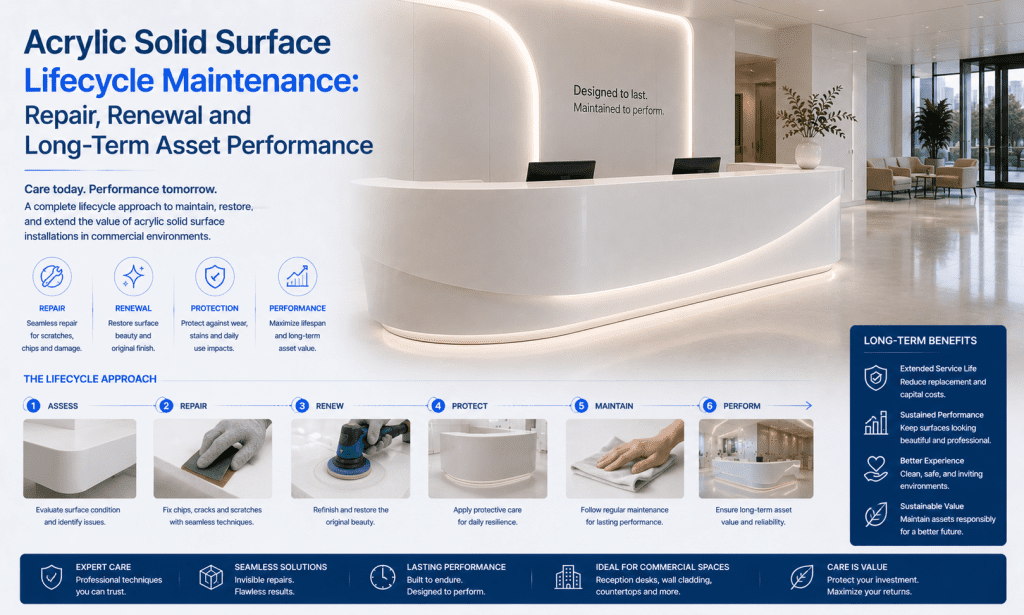
In commercial architecture, true material performance is measured not only by installation quality, but by how the material performs after years of continuous use.
A surface that requires premature replacement due to cosmetic wear, localized damage, failed seams, or declining appearance can create hidden lifecycle costs far beyond the initial purchase price.
This is where acrylic solid surface offers a meaningful long-term advantage.
Unlike decorative materials that depend on thin surface layers or finishes, acrylic solid surface is a homogeneous engineered material that can often be renewed, repaired, and refinished as part of a practical lifecycle maintenance strategy.
What Is Lifecycle Maintenance in Architectural Materials?
Lifecycle maintenance refers to the long-term strategy used to preserve a material’s performance, appearance, and usability throughout its service life.
This goes beyond routine cleaning.
It includes:
- appearance preservation
- wear management
- localized repair
- surface refinishing
- joint condition monitoring
- damage restoration
- replacement avoidance
For commercial environments, lifecycle maintenance directly influences total cost of ownership.
Why Lifecycle Performance Matters in Commercial Projects
Commercial interiors experience very different stress compared with low-use residential spaces.
Typical lifecycle stress includes:
- continuous user contact
- abrasion from repeated use
- daily facility cleaning
- localized impact damage
- surface dulling over time
- joint aging
- cosmetic wear in high-contact zones
Without lifecycle renewability, these issues can force unnecessary replacement.
What Makes Acrylic Solid Surface Different?
1. Homogeneous Full-Body Construction
Acrylic solid surface is not a decorative overlay applied to a substrate surface.
Its composition runs throughout the thickness of the material.
This structural characteristic allows surface restoration that many layered materials cannot support.
2. Repairability
Many superficial damages do not automatically require replacement.
Professionally managed repair strategies may address:
- light scratches
- localized cosmetic damage
- surface dullness
- minor impact marks
- small burn-related surface defects
This is a major lifecycle advantage for commercial asset owners.
3. Refinishability
Over time, high-contact surfaces may lose visual consistency.
Because acrylic solid surface is renewable, refinishing can help restore appearance without full replacement.
Routine Maintenance vs Lifecycle Maintenance
| Maintenance Type | Primary Goal | Typical Actions |
|---|---|---|
| Routine Maintenance | Daily usability | Cleaning, spill management, preventive care |
| Lifecycle Maintenance | Long-term asset preservation | Refinishing, repair, restoration, appearance renewal |
Common Lifecycle Intervention Scenarios
Lifecycle maintenance becomes relevant when surfaces show accumulated wear rather than isolated daily cleaning issues.
- high-contact reception desk wear
- retail counter appearance degradation
- hospitality vanity dullness
- healthcare worktop cosmetic fatigue
- surface finish inconsistency after years of use
Lifecycle Economics: Repair vs Replacement
For commercial operators, lifecycle economics matter as much as technical performance.
Replacement costs often include:
- new material cost
- fabrication cost
- site labor
- downtime
- operational disruption
- waste disposal
Where professional restoration is technically appropriate, lifecycle maintenance may significantly reduce total ownership cost.
Applications Where Lifecycle Maintenance Delivers High Value
- healthcare interiors
- hospitality vanity systems
- retail service counters
- airport public interiors
- reception desks
- commercial washrooms
- high-touch public surfaces
Relationship to Daily Maintenance
Lifecycle maintenance does not replace routine care.
Daily cleaning and preventive maintenance remain the first layer of performance protection.
For routine care guidance, see our full maintenance guide.
FAQ
Can acrylic solid surface be restored instead of replaced?
In many cases involving superficial cosmetic wear or localized damage, professional restoration may be a viable lifecycle strategy.
What is the difference between cleaning and lifecycle maintenance?
Cleaning supports daily usability. Lifecycle maintenance focuses on long-term asset preservation, renewal, and replacement avoidance.
Why is lifecycle maintenance important in commercial projects?
Because long-term operational cost often exceeds initial material purchase cost.
Talk to ACRION About Long-Term Architectural Surface Performance
ACRION supports architects, distributors, fabricators, and project buyers with architectural acrylic solid surface solutions engineered for long-term commercial lifecycle performance.