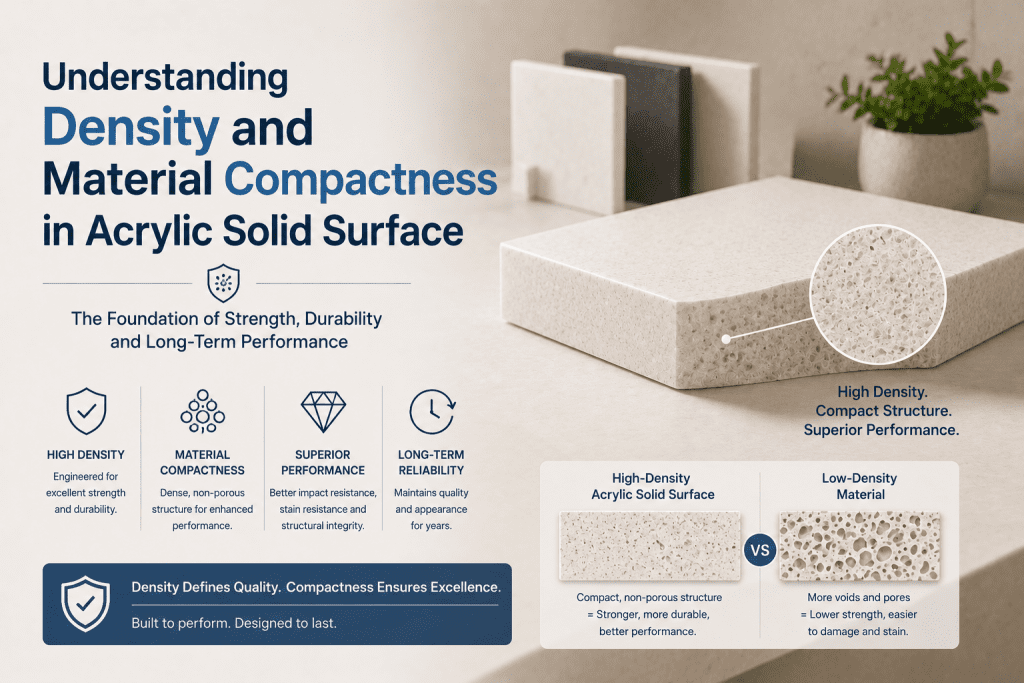
Density is one of the important physical properties of acrylic solid surface materials and plays a role in material compactness, fabrication consistency, and structural stability.
As a professional acrylic solid surface manufacturer with more than 20 years of fabrication and project experience, ACRION understands that density is often misunderstood in the market. Higher density alone does not automatically mean better overall material performance. Instead, density should be evaluated together with formulation balance, resin quality, porosity control, fabrication behavior, and long-term durability.
This article explains how density influences acrylic solid surface materials, including material compactness, fabrication characteristics, weight, porosity control, and practical application performance.
What Does Density Mean in Acrylic Solid Surface?
Density refers to the mass of a material within a specific volume and is commonly expressed in grams per cubic centimeter (g/cm³).
For acrylic solid surface materials, density is influenced by:
- Resin formulation
- Aluminum trihydrate (ATH) filler ratio
- Manufacturing consistency
- Porosity control
- Material compactness
Typical acrylic solid surface density generally falls within a range of approximately 1.65–1.80 g/cm³ depending on formulation and product structure.
Density and Material Compactness
One important effect of density is its relationship with material compactness and internal consistency.
Well-controlled manufacturing processes help reduce excessive porosity and contribute to:
- Improved surface consistency
- More stable fabrication behavior
- Better dimensional uniformity
- Reduced internal voids
- More consistent finishing performance
However, density itself is only one part of overall material engineering quality.
Density Does Not Determine All Performance Characteristics
It is important to understand that density alone does not directly determine many key performance properties of acrylic solid surface.
| Performance Property | Main Influencing Factors |
|---|---|
| Stain Resistance | Non-porous structure and resin quality |
| UV Stability | Pigment system and UV stabilizers |
| Heat Resistance | Resin chemistry and thermal stability |
| Chemical Resistance | Polymer formulation and surface chemistry |
| Repairability | Homogeneous material structure |
| Thermoforming Performance | Resin flexibility and fabrication control |
For this reason, evaluating material quality based only on density may lead to misleading conclusions.
Relationship Between Density and Porosity
Density and porosity are related to overall material compactness.
Properly manufactured acrylic solid surface materials with controlled porosity generally provide:
- Better surface consistency
- Improved hygienic performance
- Easier cleaning and maintenance
- Reduced liquid penetration risk
- More stable fabrication quality
These advantages are mainly associated with the material’s non-porous structure rather than density alone.
Density and Fabrication Performance
Density may also influence fabrication behavior during processing.
Fabricators may notice differences during:
- CNC machining
- Cutting performance
- Sanding consistency
- Polishing quality
- Seam preparation
- Thermoforming behavior
Balanced formulations are important because excessively high filler loading may sometimes contribute to:
- Reduced flexibility
- More brittle behavior
- Difficult thermoforming
- Increased fabrication stress
- Heavier sheet weight
For this reason, professional material engineering focuses on balanced formulation rather than simply maximizing density.
Density and Material Weight
Density directly affects the overall weight of acrylic solid surface sheets and fabricated products.
Higher-density materials may contribute to:
- Heavier transportation weight
- Increased handling requirements
- Higher installation load
- Additional support structure considerations
Weight considerations become particularly important in large-scale commercial projects, wall cladding systems, and custom architectural installations.
Pure Acrylic vs Modified Acrylic Density Characteristics
Different material systems may show different density characteristics depending on resin composition and filler ratio.
| Material Type | Typical Characteristics |
|---|---|
| Pure Acrylic Solid Surface | Balanced fabrication performance and long-term stability |
| Modified Acrylic Solid Surface | Density may vary depending on polyester content and filler loading |
| High Filler Ratio Materials | May increase brittleness and reduce thermoforming flexibility |
Material quality should always be evaluated through comprehensive performance rather than density values alone.
Applications Benefiting from Material Compactness
Well-manufactured acrylic solid surface materials with stable compactness are widely used in:
- Healthcare facilities
- Hospitality interiors
- Commercial reception counters
- Retail environments
- Residential kitchens and bathrooms
- Public interior architectural projects
Its balance of non-porous performance, fabrication flexibility, and renewable surface characteristics makes acrylic solid surface highly suitable for commercial interior applications.
Important Clarification About Density
Density should not be interpreted as the single indicator of overall material quality.
It is important to understand that:
- Higher density does not automatically mean better UV resistance
- Higher density does not directly determine heat resistance
- Higher density does not guarantee chemical resistance
- Balanced material formulation is more important than density alone
- Fabrication quality and resin chemistry strongly influence long-term performance
Conclusion
Density plays an important role in the compactness, structural consistency, and fabrication behavior of acrylic solid surface materials.
However, density should not be considered the sole indicator of overall material quality or long-term performance. UV stability, heat resistance, chemical resistance, and durability are influenced by multiple engineering factors including resin formulation, pigment quality, filler balance, and manufacturing consistency.
At ACRION, we continue to develop acrylic solid surface solutions engineered for balanced material performance, fabrication stability, and long-term commercial durability worldwide.