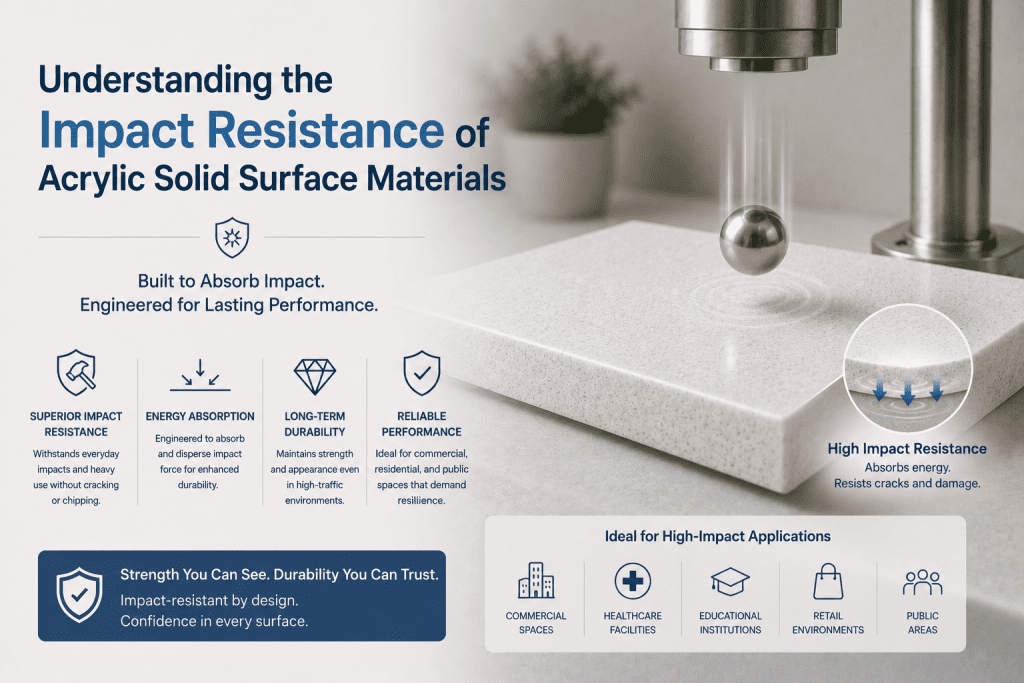
Impact resistance is an important performance consideration in commercial solid surface applications. In hospitality, healthcare, retail, and public interior environments, countertops and architectural surfaces are exposed to daily physical contact, accidental impacts, heavy object placement, and long-term operational use.
Acrylic solid surface is widely used in commercial fabrication because it provides a balanced combination of structural stability, fabrication flexibility, seamless integration, and renewable surface performance. However, the actual impact durability of a solid surface system depends not only on the material itself, but also on fabrication quality, support structure, and installation conditions.
What Is Impact Resistance in Solid Surface Materials
Impact resistance refers to the ability of a material to withstand sudden force, accidental collision, or object impact without cracking, chipping, or structural failure. In solid surface fabrication, impact performance is especially important around edges, corners, sink cutouts, and unsupported spans.
In practical commercial environments, impact resistance helps improve the long-term durability and service life of fabricated countertop systems and architectural surfaces.
Factors That Affect Impact Durability
The impact durability of acrylic solid surface is influenced by multiple factors related to both material formulation and fabrication quality.
- Resin system composition
- Filler ratio and particle distribution
- Material thickness
- Fabrication and reinforcement quality
- Substrate support conditions
- Edge design and corner radius
- Installation environment and load conditions
Pure acrylic solid surface materials generally provide better flexibility and thermoforming performance compared with polyester-modified systems, which may help improve structural consistency in certain fabrication applications.
High-Risk Areas in Countertop Fabrication
In commercial solid surface fabrication, material failure is often related more to fabrication details than to the flat surface area itself. Proper design and reinforcement are especially important in high-stress zones.
- Sink and basin cutout corners
- Cooktop openings
- Sharp inside corners
- Unsupported countertop spans
- Edge impact zones
- Thermoformed curved transitions
- Seam connection areas
Professional fabrication methods such as proper corner radius design, reinforcement strip installation, seamless bonding, and adequate substrate support play a critical role in long-term structural durability.
Commercial Applications Requiring Higher Impact Durability
Some commercial environments require higher impact durability because of heavy daily usage, public traffic, or intensive operational conditions.
- Hotel reception counters
- Restaurant serving counters
- Healthcare worktops and nurse stations
- Commercial washroom vanity systems
- Retail transaction counters
- Education and laboratory surfaces
- Public interior architectural installations
In these projects, fabrication quality and structural support are often just as important as the material specification itself.
Testing Standards and Structural Evaluation
Professional evaluation of solid surface impact durability may involve multiple laboratory testing methods related to flexural strength, impact performance, and structural stability.
Common industry reference standards may include:
- ASTM D256 – Izod Impact Resistance Testing
- ASTM D790 – Flexural Strength and Modulus Testing
- ASTM D638 – Tensile Property Evaluation
- ISO impact and structural performance standards
These testing systems help evaluate how solid surface materials respond to mechanical stress and long-term commercial use conditions.
The Importance of Professional Fabrication
In real commercial projects, the long-term structural performance of acrylic solid surface depends heavily on professional fabrication and installation practices. Even high-quality materials may experience cracking or stress failure if fabrication details are not properly controlled.
Proper seam preparation, reinforcement design, substrate support, thermoforming control, and onsite installation coordination are all critical factors in achieving reliable long-term performance.
ACRION Architectural Solid Surface Solutions
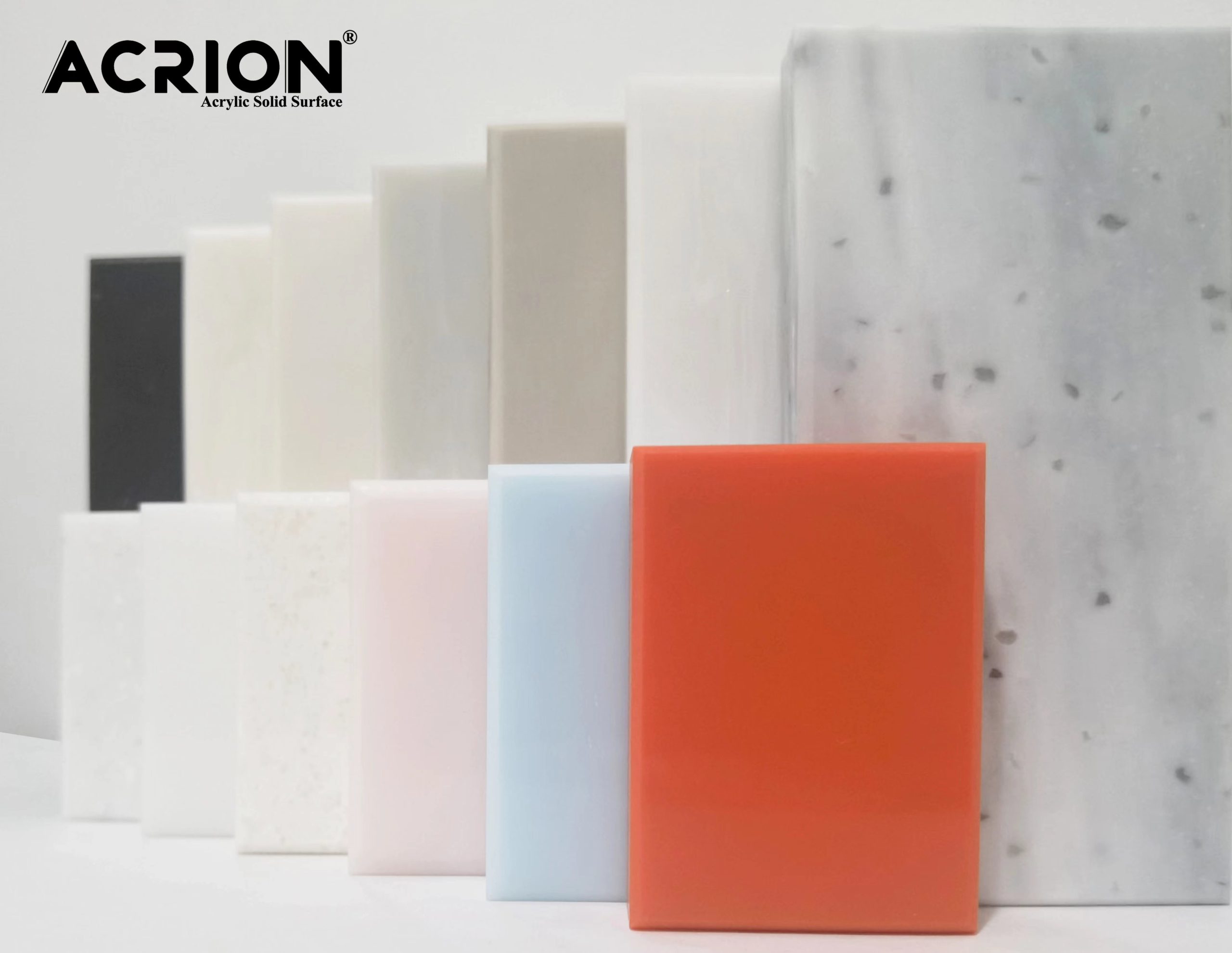
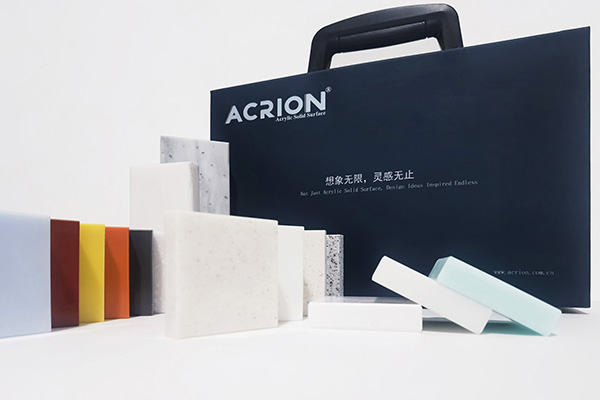
ACRION provides architectural solid surface materials for hospitality, healthcare, retail, commercial interior, and custom fabrication applications. Our acrylic solid surface products are designed for seamless fabrication, structural consistency, thermoforming flexibility, and commercial durability.
With manufacturing experience in commercial solid surface production and project-oriented fabrication support, ACRION works with architects, fabricators, contractors, and interior brands worldwide.