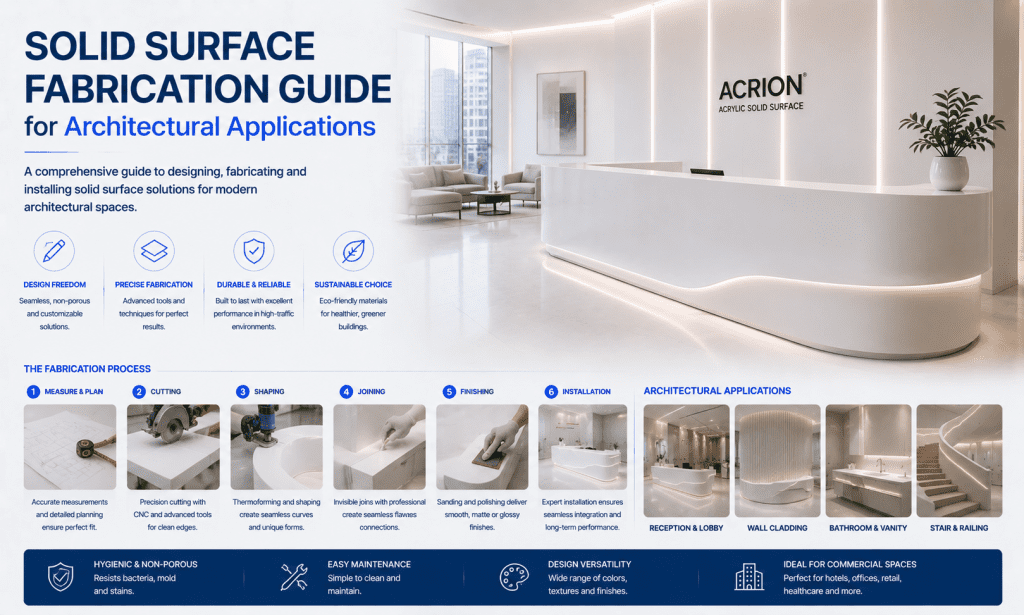
Fabrication is one of the defining advantages of acrylic solid surface as an architectural material.
Unlike many rigid decorative materials that impose design limitations, acrylic solid surface can be cut, machined, thermoformed, seamlessly joined, finished, and refined into highly customized architectural forms.
This fabrication flexibility is one reason solid surface remains widely specified in hospitality interiors, healthcare environments, retail systems, reception counters, public washrooms, commercial interiors, and custom architectural fit-out projects.
This guide provides a professional overview of how acrylic solid surface is fabricated in real-world commercial applications.
Why Fabrication Capability Matters in Architectural Material Selection
Material performance is not defined only by technical datasheets. It is also determined by how effectively the material can be fabricated into functional architectural solutions.
Architects, fabricators, and project teams often require materials that can support:
- custom dimensions
- integrated detailing
- curved geometries
- visually continuous surfaces
- precise CNC machining
- hygienic joint construction
- complex interior fit-out solutions
Acrylic solid surface is engineered specifically for these fabrication requirements.
Key Fabrication Advantages of Acrylic Solid Surface
- excellent machinability
- thermoformability for curved forms
- seamless adhesive bonding capability
- renewable surface finishing
- precise CNC compatibility
- integrated fabrication flexibility
These fabrication characteristics make acrylic solid surface highly suitable for architectural customization.
1. Cutting and Cutout Fabrication
Cutting is the foundation of solid surface fabrication.
Professional fabrication requires accurate dimensional cutting, controlled cutout preparation, and attention to internal stress management—especially around sink openings, appliance cutouts, and high-load transitions.
2. CNC Machining
Digital fabrication significantly expands design precision.
CNC machining enables repeatable fabrication for complex profiles, routed details, custom components, signage elements, and architectural integrations that would be difficult to achieve manually.
3. Drilling and Penetration Processing
Drilling requires controlled fabrication practice to preserve structural integrity.
Improper drilling techniques may create stress concentration points, cracking risks, or dimensional inaccuracy.
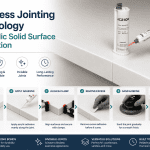
4. Seamless Jointing
Seamless jointing is one of the most recognized technical advantages of acrylic solid surface.
Color-matched adhesive bonding allows multiple panels to be integrated into visually continuous architectural surfaces with minimal visible joints.
This provides both aesthetic and hygiene advantages in commercial applications.
5. Adhesive Bonding Systems
Professional fabrication depends on appropriate adhesive systems, joint preparation, curing discipline, and consistent bonding practice.
6. Thermoforming and Curved Fabrication
Thermoforming allows acrylic solid surface to be heated and shaped into controlled curved geometries.
This fabrication capability enables fluid architectural forms that are difficult or impossible with many conventional surfacing materials.
7. Surface Finishing
Final surface quality is heavily influenced by finishing methodology.
Proper sanding progression, polishing control, and finish consistency directly affect the visual and tactile quality of the completed installation.
8. Integrated Detailing and Backsplash Fabrication
Solid surface allows integrated detailing such as coved transitions, upstands, backsplashes, and hygiene-focused detailing that improve both aesthetics and cleanability.
9. Fabrication Equipment Considerations
Consistent fabrication quality depends not only on material but also on tooling, machinery, and workshop capability.
Common Fabrication Mistakes
- poor joint preparation
- incorrect adhesive practice
- stress-inducing cut geometry
- inconsistent finishing workflow
- improper thermoforming temperature control
- tooling mismatch
Applications That Benefit from Advanced Fabrication
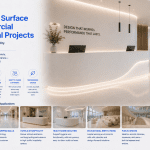
- reception desks
- healthcare counters
- hospitality vanities
- retail display systems
- airport interiors
- commercial washrooms
- custom architectural fit-outs
FAQ
Is acrylic solid surface easy to fabricate?
Compared with many rigid decorative materials, acrylic solid surface offers excellent machinability, thermoforming capability, and seamless fabrication flexibility.
Can solid surface be CNC machined?
Yes. CNC machining is widely used for precision fabrication of acrylic solid surface components.
Why is seamless fabrication important?
Seamless fabrication improves visual continuity, hygiene performance, and architectural detailing quality.
Talk to ACRION About Architectural Fabrication Solutions
ACRION supports architects, distributors, fabricators, and project buyers with architectural acrylic solid surface materials engineered for advanced fabrication flexibility.