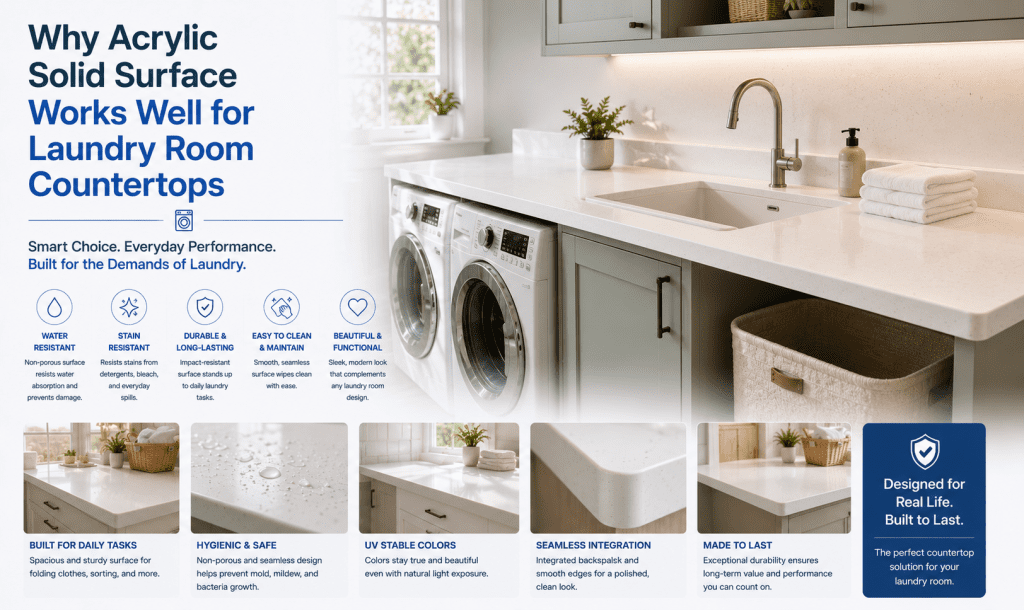
Laundry rooms and utility spaces require countertop materials that can withstand moisture exposure, daily cleaning, detergents, and long-term household or commercial use. Acrylic solid surface has become a popular solution for modern laundry room countertops because of its seamless fabrication capability, non-porous performance, and ease of maintenance.
Compared with traditional tiled surfaces or laminate countertops, acrylic solid surface provides a cleaner appearance, fewer moisture-prone joints, and greater design flexibility for integrated utility spaces.
Why Laundry Rooms Require Moisture-Resistant Countertops
Laundry rooms are exposed daily to water, humidity, detergent residue, bleach, and routine cleaning procedures. Countertop materials used in these environments must provide good moisture resistance and long-term surface stability.
Acrylic solid surface offers a non-porous material structure that helps reduce water penetration and simplifies maintenance in utility environments.
Seamless Countertop and Sink Integration
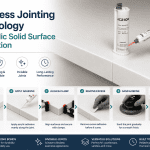
One of the major advantages of acrylic solid surface is seamless fabrication. Utility sinks and wash basins can be integrated directly into the countertop with minimal visible joints.
This seamless construction helps reduce moisture accumulation around sink edges and countertop seams, creating a cleaner and more refined utility workspace.
Non-Porous Performance for Utility Spaces
Unlike some porous countertop materials, acrylic solid surface does not require additional waterproof coating treatment during normal fabrication and installation processes.
Its non-porous surface helps resist moisture penetration and supports easier routine cleaning for residential and commercial laundry room applications.
Resistance to Detergents and Cleaning Chemicals
Laundry countertops regularly come into contact with detergent, fabric softener, bleach, and cleaning products. Acrylic solid surface offers good resistance against many commonly used household cleaning chemicals when maintained properly.
Routine maintenance generally involves mild detergent cleaning and soft cloth wiping procedures. Minor surface scratches may also be renewable through sanding and refinishing techniques.
Integrated Utility Room Design Possibilities
Modern laundry room design increasingly emphasizes integrated storage systems, concealed utility functions, and minimalist countertop layouts. Acrylic solid surface supports customized fabrication for utility counters, folding stations, integrated backsplashes, floating shelves, and sink worktops.
The material can also be fabricated with curved edges and seamless transitions to create a cleaner architectural appearance.
Easy Cleaning and Long-Term Maintenance
Utility spaces require countertop materials that are practical for frequent daily use. Acrylic solid surface supports easy routine cleaning because of its smooth and consistent surface structure.
In long-term use environments, renewable sanding and refinishing capabilities help maintain the countertop’s appearance and extend service life.
Conclusion
Acrylic solid surface combines seamless fabrication, non-porous performance, moisture resistance, and fabrication flexibility, making it highly suitable for modern laundry room countertops and utility space applications.
From integrated sink systems to utility counters and storage worktops, the material provides designers and fabricators with a practical and visually clean solution for contemporary utility room design.