Modern public spaces increasingly require surface materials that combine durability, seamless fabrication, maintenance efficiency, and architectural consistency. Acrylic solid surface is widely used in public architectural interiors because of its non-porous structure, fabrication flexibility, and suitability for high-traffic environments.
From reception counters and transportation facilities to public washrooms and integrated commercial interiors, acrylic solid surface supports a wide range of public architectural applications that require both functional performance and long-term durability.
Why Public Spaces Require Durable Surface Materials
Public spaces experience continuous daily use from visitors, staff members, customers, and large circulation traffic. Surface materials used in these environments must withstand long-term wear, routine cleaning, impact exposure, and frequent public interaction.
Acrylic solid surface provides a durable and renewable surface solution suitable for many commercial and civic interior environments where long-term maintenance efficiency is important.
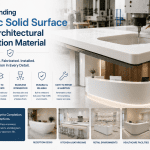
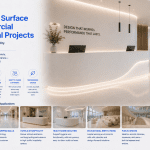
Reception and Information Counter Applications
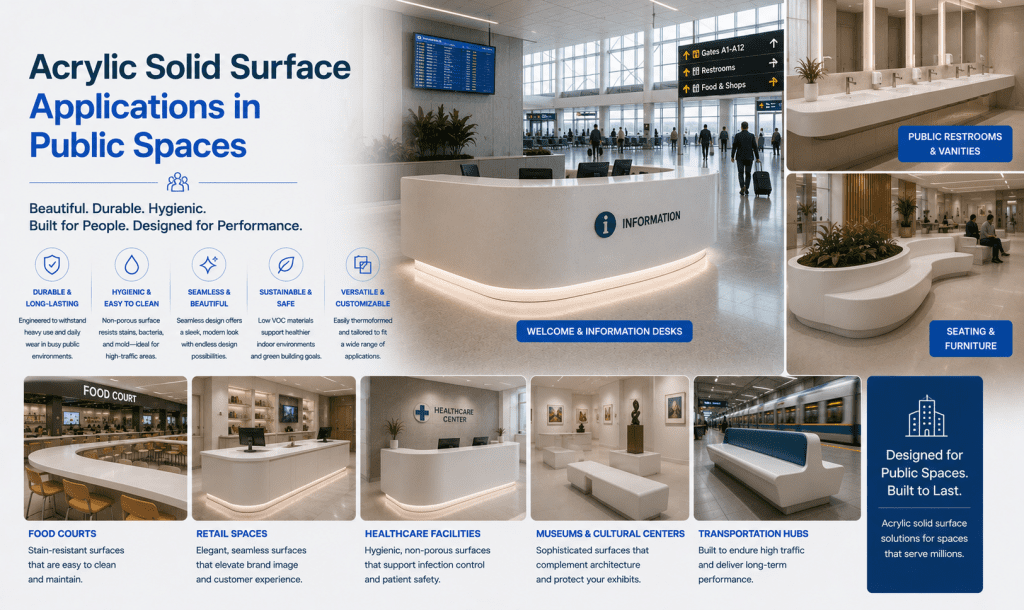
Reception counters, information desks, service stations, and customer interaction surfaces are among the most common public space applications for acrylic solid surface.
The material supports seamless counter fabrication, curved geometry, integrated lighting systems, and customized architectural detailing for modern commercial and institutional interiors.
Large continuous countertop surfaces also help maintain cleaner visual consistency across high-traffic public environments.
Public Washroom and Hygienic Surface Systems
Public washrooms, hand-washing stations, and hygienic service areas require surface materials that support easy maintenance and seamless cleaning procedures.
Acrylic solid surface is commonly used for integrated wash basins, vanity systems, wall cladding, and public wash station countertops because of its non-porous structure and integrated fabrication capability.
Seamless sink integration and coved backsplash systems help reduce moisture-prone joints while simplifying routine maintenance procedures.
Transportation and Commercial Interior Applications
Transportation facilities and commercial buildings increasingly use acrylic solid surface for ticket counters, service desks, waiting areas, wall systems, and integrated public interiors.
Airports, transportation hubs, commercial lobbies, exhibition halls, and civic buildings often require customized architectural surfaces capable of supporting long-term public use.
The fabrication flexibility of acrylic solid surface allows architects and fabricators to create seamless integrated public interior systems with cleaner visual continuity.
Integrated Public Furniture and Architectural Features
Modern public interiors increasingly incorporate integrated furniture systems, architectural seating, wall cladding elements, and customized public interaction surfaces.
Acrylic solid surface supports CNC fabrication, thermoforming, curved geometry, and customized edge detailing for integrated public architectural systems.
Its fabrication flexibility allows designers to create sculptural forms, seamless furniture systems, and visually consistent commercial interiors.
Low-Maintenance Surface Systems for High-Traffic Environments
Maintenance efficiency is one of the most important considerations in public architectural environments. Acrylic solid surface supports easier cleaning procedures because of its smooth and non-porous surface structure.
Minor scratches and surface wear can often be renewed through sanding and refinishing procedures, helping extend the long-term lifecycle of public interior surfaces.
Why Designers and Fabricators Choose Acrylic Solid Surface for Public Projects
Compared with many traditional public interior surface materials, acrylic solid surface offers greater fabrication flexibility for customized architectural projects.
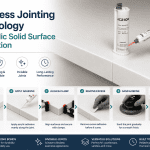
The material can be seamlessly joined, thermoformed, CNC processed, integrated with lighting systems, and fabricated into customized commercial and civic interior applications.
This flexibility helps architects, designers, and fabricators create more durable, visually consistent, and maintenance-efficient public environments.
Common Public Space Applications
- Comptoirs d'accueil
- Information desks
- Public wash stations
- Transportation service counters
- Commercial lobby surfaces
- Museum and exhibition counters
- Integrated architectural seating
- Systèmes de vanité pour toilettes publiques
- Wayfinding and service counters
- Systèmes de revêtement mural
Foire aux questions
Why is acrylic solid surface suitable for public spaces?
Acrylic solid surface offers durability, seamless fabrication, hygienic performance, and maintenance efficiency suitable for high-traffic public environments.
Can acrylic solid surface be used for reception counters?
Yes. Acrylic solid surface is widely used for reception desks, information counters, service stations, and public interaction surfaces.
Is acrylic solid surface suitable for public washrooms?
Yes. The material is commonly used for integrated wash basins, vanity systems, and hygienic wash station applications.
Can acrylic solid surface be thermoformed for public interiors?
Yes. Acrylic solid surface can be thermoformed into curved geometry and customized architectural forms for commercial and civic interior projects.
Is acrylic solid surface easy to maintain in high-traffic areas?
Its non-porous structure and renewable surface capability help simplify cleaning and long-term maintenance procedures in public environments.
Conclusion
Acrylic solid surface combines durability, seamless fabrication, hygienic performance, thermoforming flexibility, and long-term maintenance efficiency, making it highly suitable for modern public architectural interiors and high-traffic commercial environments.
From transportation facilities and public washrooms to reception counters and integrated commercial interiors, acrylic solid surface continues to support public architectural systems that require durability, visual consistency, and customized fabrication flexibility.