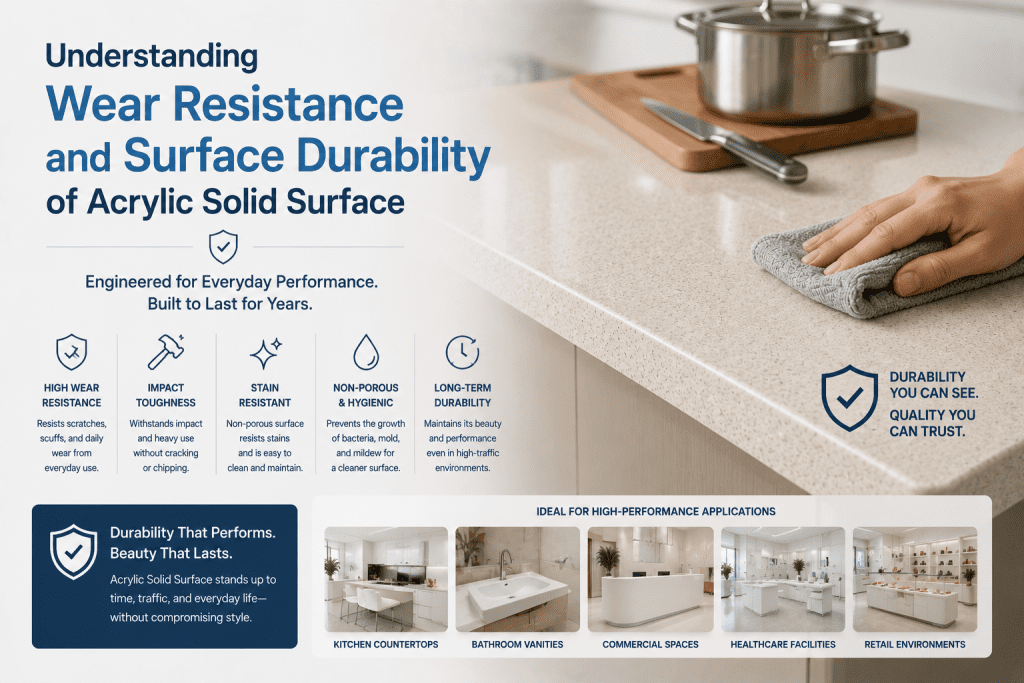
Wear resistance is an important performance characteristic for acrylic solid surface materials used in commercial interiors, healthcare facilities, hospitality environments, retail systems, and high-traffic architectural applications.
As a professional acrylic solid surface manufacturer with more than 20 years of fabrication and project experience, ACRION understands that wear resistance is often misunderstood in the market. Acrylic solid surface is not a completely scratch-proof material, but its balance of surface durability, toughness, and renewable repairability makes it highly suitable for long-term commercial use.
This article explains how wear resistance of acrylic solid surface materials should be properly understood from both engineering and maintenance perspectives.
Qu’est-ce que la résistance à l’usure ?
Wear resistance refers to a material’s ability to maintain surface integrity and appearance under repeated friction, abrasion, and daily mechanical use.
In architectural surface materials, wear resistance is influenced by:
- Material composition
- Resin quality
- Mineral filler structure
- Finition de surface
- Procédures d'entretien
- Usage environment
For acrylic solid surface, wear performance should be evaluated together with repairability and long-term maintenance capability.
Difference Between Wear Resistance and Scratch Resistance
Wear resistance and scratch resistance are related but different material performance characteristics.
| Type de performances | Description |
|---|---|
| Résistance à l'usure | Long-term resistance to repeated friction and surface abrasion |
| Résistance aux rayures | Resistance to localized sharp object scratching |
| Résistance aux chocs | Ability to resist cracking or damage from impact forces |
Acrylic solid surface provides balanced overall surface durability rather than extreme hardness alone.
Material Structure and Wear Performance
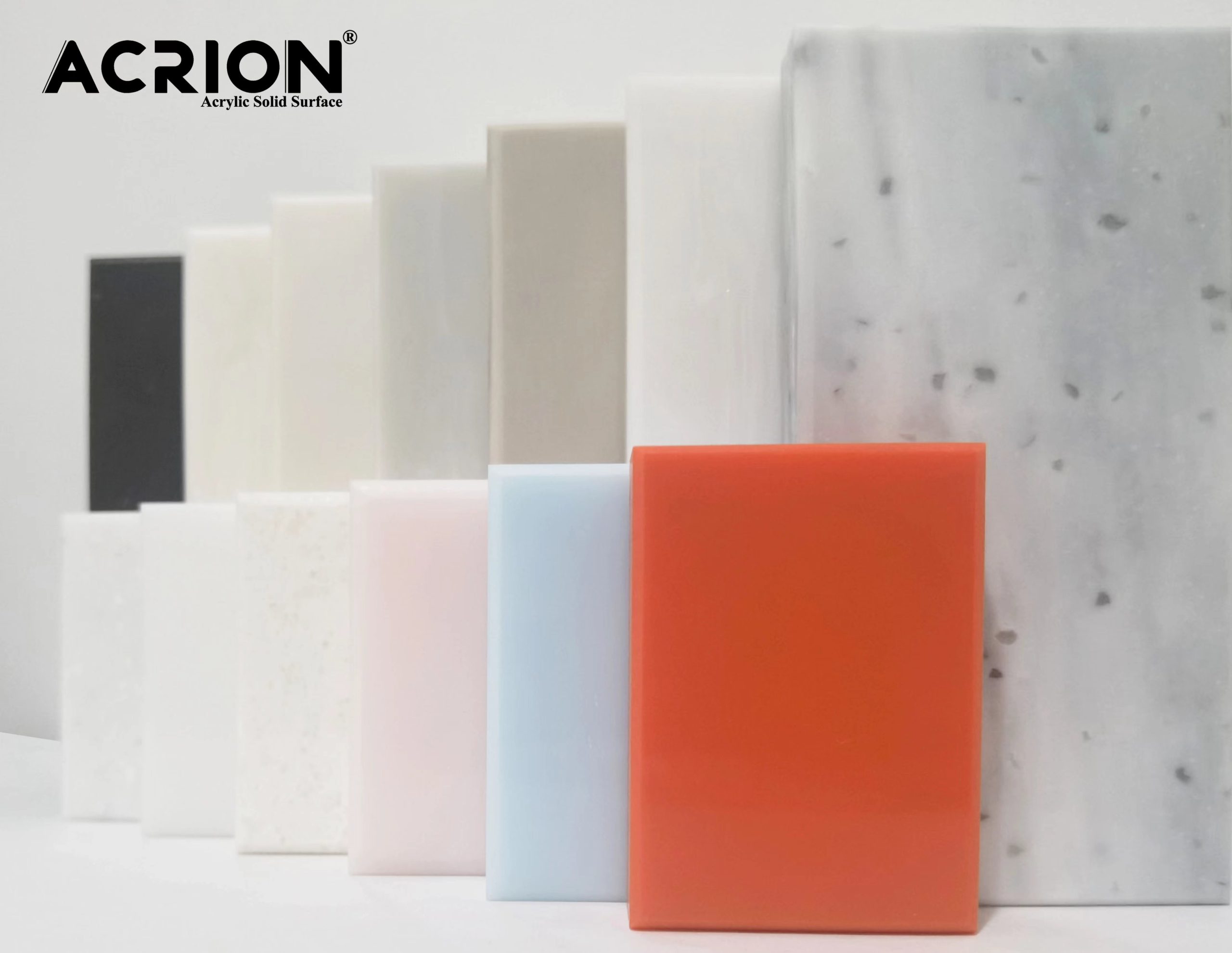
Acrylic solid surface is typically manufactured using acrylic resin systems combined with engineered mineral fillers such as aluminum trihydrate (ATH).
This engineered material structure contributes to:
- Surface stability
- Balanced toughness
- Résistance aux chocs
- Fabrication flexibility
- Long-term maintenance capability
The balance between hardness and toughness is important because excessively hard materials may become brittle or difficult to repair.
Surface Finish and Wear Visibility
Surface finish plays an important role in long-term appearance performance.
Different finishes may influence:
- Scratch visibility
- Rétention de brillance
- Cleaning appearance
- Wear visibility
- Maintenance frequency
In general:
- Matte finishes may better hide light scratches
- Gloss finishes may show surface wear more visibly
- Darker colors may reveal scratches more easily than lighter colors
Proper finish selection is important for high-traffic commercial environments.
Wear Resistance in Commercial Applications
Acrylic solid surface is widely used in commercial environments requiring long-term surface durability and maintainability.
- Comptoirs d'accueil des hôpitaux
- Retail checkout systems
- Dessus de vanité d'hôtel
- Toilettes commerciales
- Comptoirs de restaurants
- Plans de travail pour le secteur médical
In these environments, the material is valued not only for initial appearance but also for its long-term maintenance flexibility and repairability.
Technologie de surface renouvelable
L’un des avantages les plus importants de la surface solide acrylique est sa capacité de surface renouvelable.
Because the material is homogeneous throughout its thickness, minor surface wear or scratches can often be restored through:
- Ponçage professionnel
- Finition de surface
- Procédures de polissage
- Travaux de réparation localisés
This renewable maintenance capability significantly extends the service life of the material in commercial applications.
Comparaison avec d'autres matériaux de surface
Different architectural materials offer different durability characteristics.
| Matériel | Main Durability Characteristic |
|---|---|
| Surface solide acrylique | Balanced wear resistance and repairability |
| Surface de quartz | Higher scratch resistance but limited repairability |
| Pierre frittée | Excellent hardness and heat resistance |
| Stratifié | Lower repairability after surface damage |
The major advantage of acrylic solid surface lies in the combination of durability, fabrication flexibility, and renewable maintenance.
Important Usage Considerations
Although acrylic solid surface offers strong wear performance for commercial interiors, proper usage practices remain important.
- Direct cutting on the surface is not recommended
- Sharp metal objects may still scratch the material
- Protective cutting boards should be used in kitchen environments
- Routine maintenance helps preserve long-term appearance
Like all architectural materials, long-term performance depends on proper fabrication, installation, maintenance, and daily usage conditions.
Wear Resistance and Lifecycle Maintenance
In commercial architecture, long-term maintenance cost is often more important than extreme initial hardness.
The renewable surface capability of acrylic solid surface allows damaged areas to often be restored rather than completely replaced.
This maintenance flexibility helps reduce:
- Fréquence de remplacement
- Long-term operational cost
- Visual aging
- Commercial downtime
For this reason, acrylic solid surface remains highly valued in commercial interior environments requiring long-term maintainability.
Conclusion
Acrylic solid surface provides balanced surface durability through the combination of wear resistance, toughness, fabrication flexibility, and renewable surface technology.
Although it is not completely scratch-proof, its ability to be repaired and refinished makes it highly suitable for healthcare, hospitality, retail, and commercial interior applications.
Its long-term value comes not only from initial appearance performance, but also from its maintainability throughout the commercial lifecycle of the project.
At ACRION, we continue to develop acrylic solid surface solutions engineered for architectural durability, fabrication reliability, and long-term commercial maintenance performance worldwide.