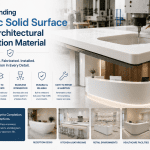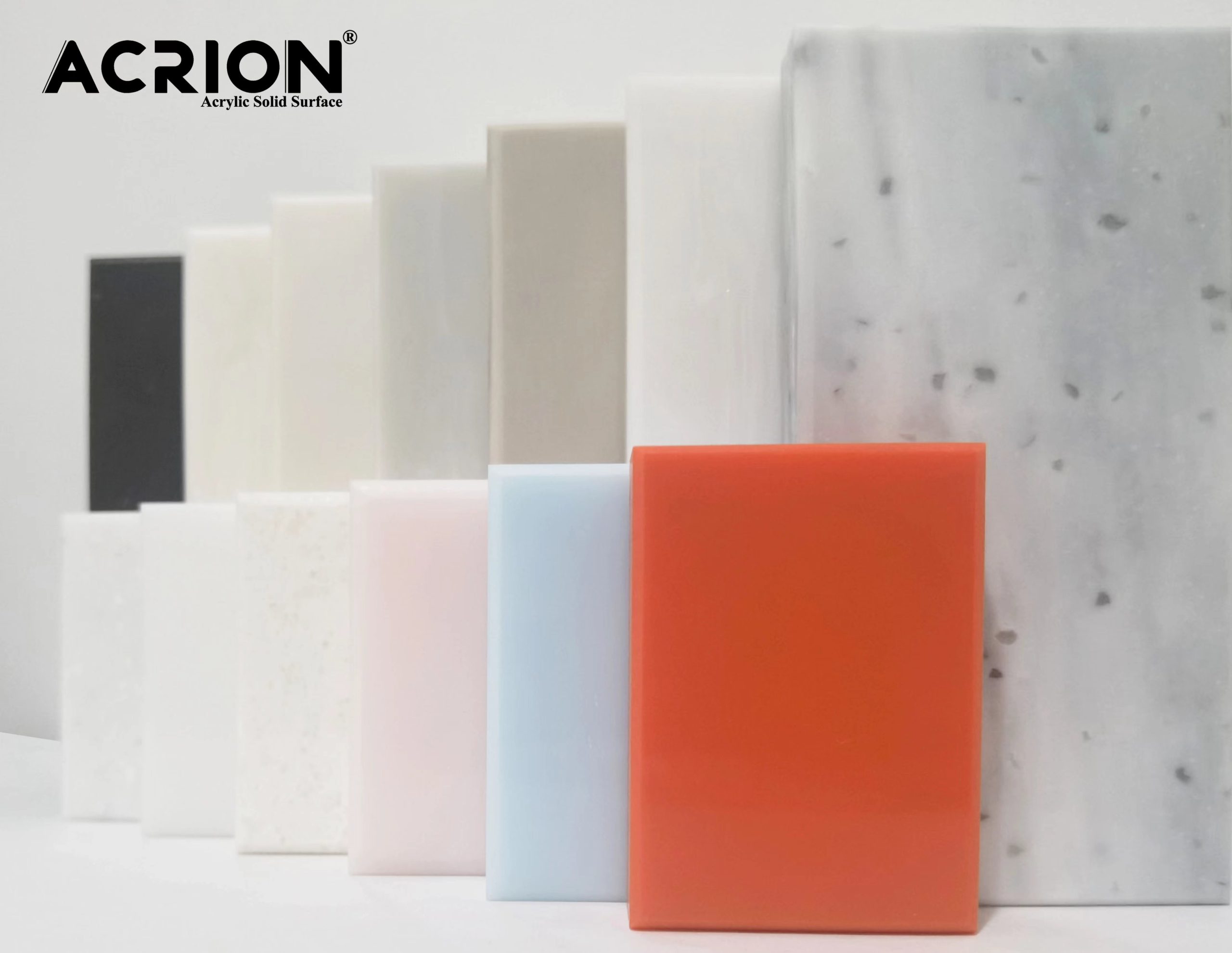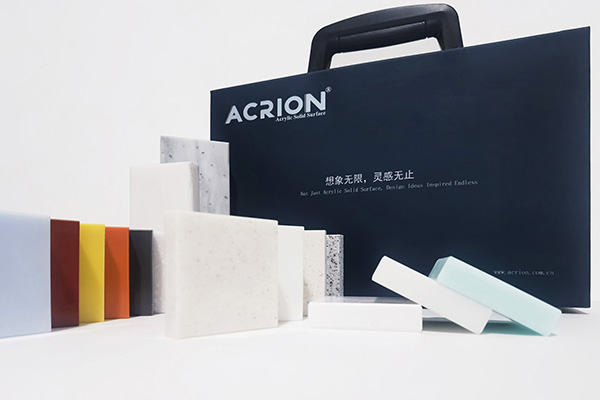
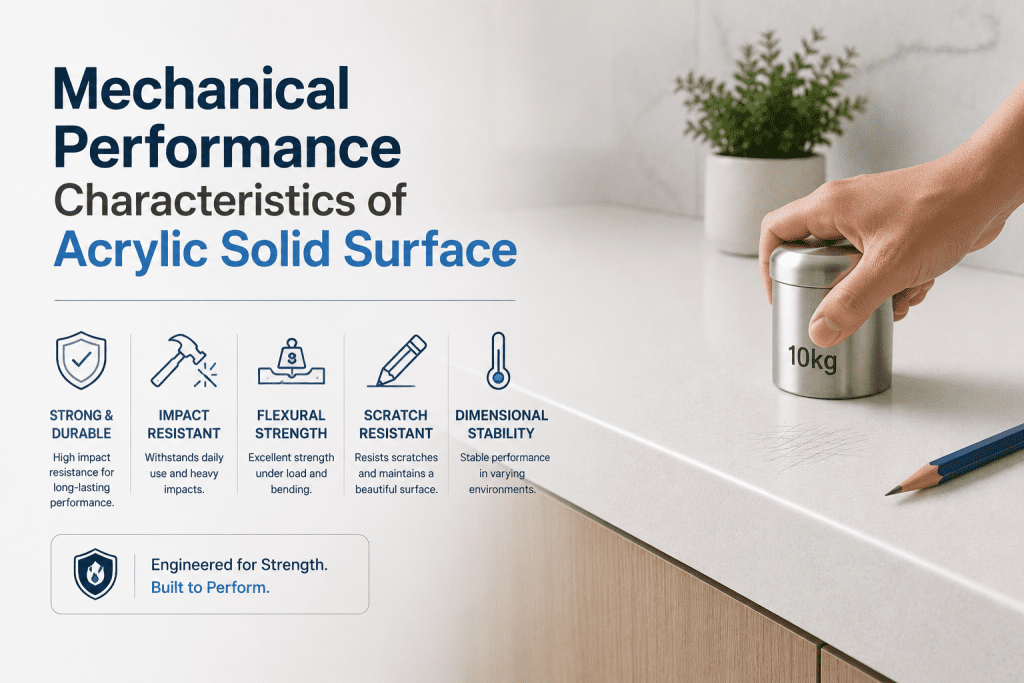
La surface solide acrylique est largement utilisée dans les établissements de santé, les projets hôteliers, les intérieurs commerciaux, les laboratoires et les applications résidentielles en raison de ses performances mécaniques équilibrées, de sa capacité de fabrication sans couture et de sa flexibilité de conception.
En tant que fabricant professionnel de surfaces solides en acrylique avec plus de 20 ans d'expérience en fabrication et en projets, ACRION comprend que la performance à long terme des matériaux à surface solide dépend non seulement de l'esthétique, mais également de la stabilité structurelle, de la résistance aux chocs, de l'ouvrabilité de la fabrication et du comportement mécanique global.
Mechanical properties such as flexural strength, flexural modulus, impact resistance, and thermoforming capability all contribute to the practical performance of acrylic solid surface in commercial and architectural environments.
What Is Flexural Modulus?
Flexural modulus, sometimes referred to as bending modulus or elastic modulus in bending applications, measures the stiffness of a material when subjected to bending forces.
In simple terms, a higher flexural modulus generally means the material is more resistant to bending deformation under load.
For acrylic solid surface materials, flexural modulus is one of several important mechanical indicators used to evaluate structural performance.
Flexural Strength vs Flexural Modulus
Flexural strength and flexural modulus are related but different material properties.
| Propriété | Description |
|---|---|
| Résistance à la flexion | Measures how much bending stress the material can withstand before failure |
| Module de flexion | Measures the stiffness of the material during bending |
| Résistance aux chocs | Measures the ability to resist sudden impact forces |
| Capacité de thermoformage | Measures the material’s ability to be shaped under controlled heating conditions |
In practical fabrication and architectural applications, balanced mechanical performance is usually more important than focusing on a single property alone.
Why Mechanical Performance Matters in Solid Surface Applications
In commercial and residential environments, acrylic solid surface materials are often exposed to:
- Daily impact from objects
- Long-span countertop installations
- Fabrication stress during machining
- Thermal forming processes
- Usage intensif dans les environnements publics
Pour cette raison, une bonne stabilité structurelle et un comportement mécanique équilibré sont essentiels pour des performances à long terme.
Résistance aux chocs de la surface solide acrylique
Par rapport à certains matériaux en pierre rigide, la surface solide acrylique offre généralement une meilleure tolérance aux chocs et une moindre fragilité.
Cela permet de réduire le risque de fissuration soudaine ou d’écaillage des bords lors des processus normaux d’utilisation et de fabrication.
Dans des applications pratiques telles que les plans de travail de soins de santé, les comptoirs de réception commerciaux, les comptoirs de laboratoire et les cuisines résidentielles, la résistance aux chocs contribue à améliorer la durabilité à long terme.
Capacité de thermoformage et flexibilité de fabrication
L’un des principaux avantages de la surface solide acrylique par rapport aux matériaux tels que la surface en quartz est sa capacité de thermoformage.
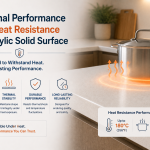
Under controlled heating conditions, acrylic solid surface can be shaped into curved and complex architectural forms.
Les applications courantes du thermoformage comprennent :
- Banques d'accueil courbes
- Dosserets intégrés
- Postes de travail de santé
- Comptoirs commerciaux sur mesure
- Organic architectural shapes
It is important to understand that thermoforming capability is mainly related to the polymer composition and heat-forming behavior of the material rather than simply having a high flexural modulus.
Comparison Between Acrylic Solid Surface and Quartz Surface
| Propriété | Surface solide acrylique | Surface de quartz |
|---|---|---|
| Capacité de thermoformage | Oui | Non |
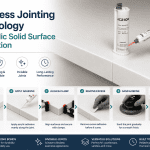
| Fabrication sans couture | Excellent | Limité |
| Réparabilité | Renewable surface | More difficult to repair |
| Brittleness | Inférieur | Plus haut |
| Flexibilité de conception | Haut | Modéré |
This balance between mechanical performance and fabrication flexibility is one of the reasons acrylic solid surface remains highly popular in architectural applications.
Factors Affecting Mechanical Performance
The mechanical performance of acrylic solid surface can vary depending on several technical factors.
- Formulation de résine
- Taux de remplissage ATH
- Manufacturing quality
- Épaisseur de la feuille
- Fabrication methods
- Support structure design
- Installation quality
For this reason, professional fabrication and proper installation are essential for achieving long-term structural stability.
Applications Requiring Good Mechanical Stability
Applications where balanced mechanical performance is particularly important include:
- Healthcare environments
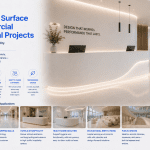
- Espaces de réception commerciale
- Plans de travail de laboratoire
- Hospitality counters
- Systèmes d'affichage pour la vente au détail
- Cuisines et salles de bains résidentielles
In these environments, the combination of structural stability, seamless fabrication, and repairability contributes to long-term material performance.
Conclusion
Acrylic solid surface is valued not simply for a single mechanical property, but for its balanced combination of flexural strength, structural stability, impact resistance, thermoforming capability, and fabrication flexibility.
Compared with many traditional surface materials, acrylic solid surface provides an excellent balance between mechanical performance, design freedom, seamless fabrication, and long-term maintainability.
At ACRION, we continue to develop acrylic solid surface solutions engineered for architectural fabrication, commercial durability, and advanced design applications worldwide.