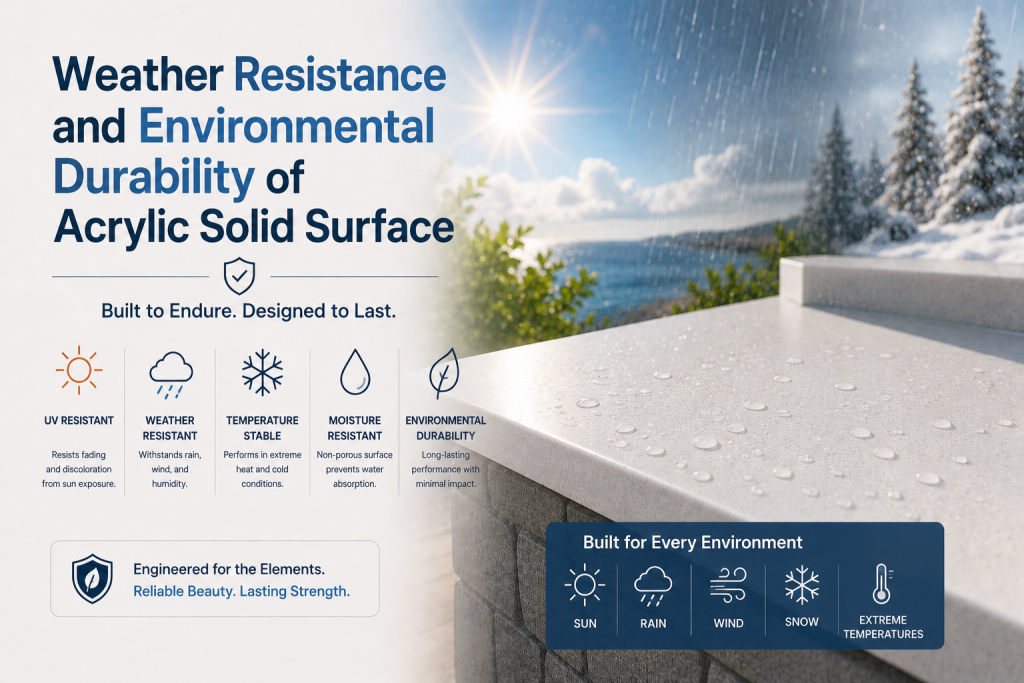
Weather resistance is an important consideration for architects, designers, fabricators, and project developers when evaluating the long-term durability of surface materials used in commercial and architectural environments.
As a professional acrylic solid surface manufacturer with more than 20 years of fabrication and project experience, ACRION understands that weather resistance is often misunderstood in the market. Environmental durability is not determined by a single factor, but by the material’s overall ability to maintain appearance and structural stability under long-term environmental exposure.
This article explains how acrylic solid surface performs under weathering conditions, including UV exposure, humidity, temperature variation, and long-term environmental aging.
What Does Weather Resistance Mean?
Weather resistance refers to a material’s ability to maintain its appearance and physical performance after long-term exposure to environmental conditions.
Environmental aging may involve multiple factors such as:
- Ultraviolet radiation (UV)
- Humidity and moisture
- Temperature fluctuation
- Ciclismo térmico
- Surface oxidation
- Air pollutants
- Long-term sunlight exposure
For acrylic solid surface materials, weather resistance is closely related to resin formulation, pigment stability, manufacturing quality, and environmental exposure conditions.
UV Stability and Color Retention
One important aspect of weather resistance is UV stability and long-term color retention.
Compared with many polyester-based surface materials, high-quality pure acrylic solid surface generally provides better resistance to:
- Yellowing
- Color fading
- Surface chalking
- Redução de brilho
- Inconsistência visual
This improved stability is mainly related to the chemical characteristics of acrylic resin systems, UV stabilizers, and pigment quality rather than simply having a non-porous surface structure.
However, like all polymer-based materials, acrylic solid surface may still experience gradual environmental aging after prolonged UV exposure, especially in harsh outdoor environments.
Moisture Resistance and Environmental Stability
Acrylic solid surface is widely recognized for its non-porous structure and low water absorption characteristics.
These properties contribute to:
- Good moisture resistance
- Fácil limpeza e manutenção
- Melhor desempenho higiênico
- Reduced risk of water penetration
For this reason, acrylic solid surface is commonly used in environments such as:
- Banheiros
- Instalações de saúde
- Commercial wash areas
- Interiores de hospitalidade
- Cozinhas residenciais
Seu desempenho de resistência à umidade o torna adequado para muitas aplicações internas com alta umidade.
Aplicações internas versus externas
A superfície sólida acrílica é projetada principalmente para aplicações arquitetônicas de interiores, em vez de exposição externa permanente.
Embora certos produtos de superfície sólida acrílica possam funcionar bem em ambientes externos semi-expostos ou limitados, a exposição externa direta e prolongada pode aumentar o risco de:
- Mudança de cor
- Tensão de expansão térmica
- Envelhecimento superficial
- Movimento articular
- Redução de brilho
- Mudanças na superfície relacionadas ao clima
A velocidade de envelhecimento ambiental pode variar significativamente dependendo de:
- Condições climáticas
- Intensidade UV
- Variação de temperatura
- Projeto de instalação
- Seleção de cores
- Duração da exposição
Cores escuras e ambientes externos de alta temperatura podem apresentar efeitos de desgaste mais visíveis ao longo do tempo.
Teste de intemperismo acelerado
Professional weather resistance evaluation is commonly performed through accelerated weathering tests conducted under controlled laboratory conditions.
Common testing standards may include:
- ASTM G154
- ASTM G155
- ISO 4892
- QUV accelerated weathering testing
- Xenon arc exposure testing
These testing methods simulate long-term environmental exposure including UV radiation, moisture, and temperature cycling in order to evaluate color stability and surface durability.
Actual outdoor performance may still vary depending on regional climate and project conditions.
Thermal Cycling and Environmental Movement
Temperature fluctuation may cause expansion and contraction in polymer-based architectural materials.
In long-term outdoor or semi-outdoor environments, thermal cycling may contribute to:
- Joint stress
- Expansion movement
- Fabrication stress concentration
- Potential seam visibility changes
For this reason, proper fabrication methods, expansion allowance, and installation support are important for maintaining long-term structural stability.
Pure Acrylic vs Modified Acrylic Weather Stability
Weather resistance performance may vary depending on material formulation.
| Tipo de material | Typical Weather Stability |
|---|---|
| Superfície sólida acrílica pura | Generally better long-term color stability and UV resistance |
| Superfície sólida acrílica modificada | May show faster environmental aging depending on polyester content |
| Polyester-Based Surface Materials | Typically lower long-term UV stability |
This is one reason why pure acrylic solid surface is often preferred for higher-end commercial and architectural projects.
Important Clarification About Weather Resistance
Weather resistance should not be confused with permanent outdoor durability under all environmental conditions.
É importante entender que:
- All polymer materials experience some degree of environmental aging over time
- UV resistance does not mean permanent non-yellowing performance
- Outdoor weathering conditions vary significantly by region
- Testing standards evaluate performance under controlled conditions
- Long-term exterior applications require careful project evaluation
For demanding outdoor projects, project-specific environmental testing and material evaluation are strongly recommended.
Applications Benefiting from Good Environmental Stability
Acrylic solid surface is widely used in environments where long-term interior durability and moisture resistance are important.
- Instalações de saúde
- Interiores de hospitalidade
- Banheiros comerciais
- Ambientes de varejo
- Cozinhas e banheiros residenciais
- Projetos arquitetônicos de interiores públicos
Seu equilíbrio entre estabilidade ambiental, fabricação perfeita e características de superfície renováveis o tornam altamente prático para aplicações internas comerciais.
Conclusão
A superfície sólida acrílica oferece boa durabilidade ambiental e resistência às intempéries para muitas aplicações arquitetônicas de interiores, especialmente quando são usadas formulações acrílicas puras de alta qualidade.
Em comparação com muitos materiais à base de poliéster, a superfície sólida acrílica geralmente oferece melhor estabilidade UV, retenção de cor e consistência de aparência a longo prazo.
Contudo, a resistência às intempéries não deve ser interpretada como durabilidade ilimitada ao ar livre sob todas as condições ambientais. A exposição externa de longo prazo ainda requer uma avaliação cuidadosa do clima, da intensidade dos raios UV, do projeto da instalação e da formulação do material.
At ACRION, we continue to develop acrylic solid surface solutions engineered for architectural fabrication, environmental stability, and long-term commercial durability worldwide.