When evaluating surfacing materials for commercial interiors, buyers often ask simple questions:
Is it scratch resistant?
Is it hard enough?
Will it wear out over time?
These are valid questions—but they are often based on a misunderstanding of material mechanics.
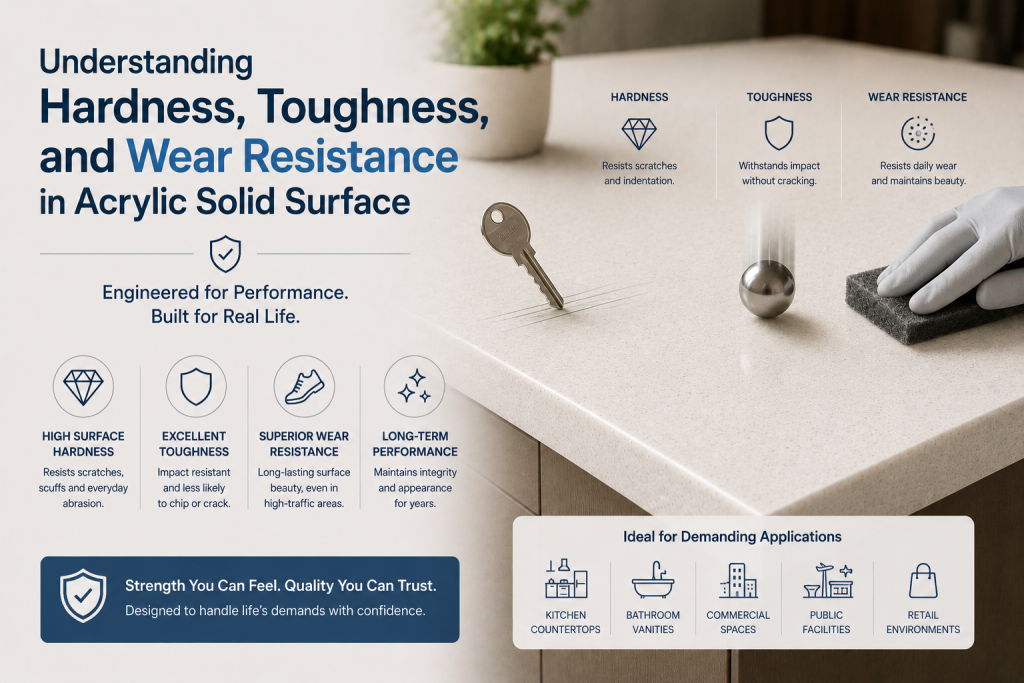
Hardness, toughness, and wear resistance are related, but they are not the same property.
For acrylic solid surface, understanding these differences is essential for correct specification in hospitality, healthcare, retail, reception, and other commercial architectural environments.
Why These Mechanical Terms Are Often Confused
In material discussions, “strong,” “hard,” “scratch resistant,” and “durable” are often used interchangeably.
From an engineering perspective, these describe different behaviors under different types of stress.
A material may be:
- hard but brittle
- tough but softer
- wear resistant but repairable
- impact tolerant but easier to scratch
Correct material evaluation requires understanding the distinctions.
What Is Hardness?
Hardness refers to a material’s resistance to surface indentation, localized deformation, or superficial abrasion.
In practical commercial use, hardness influences:
- surface mark visibility
- contact wear behavior
- abrasion response
- scratch sensitivity perception
However, hardness alone does not determine long-term performance.
A very hard decorative material may resist scratching but fail catastrophically under impact.
What Is Toughness?
Toughness refers to a material’s ability to absorb energy and resist fracture under stress or impact.
This becomes important in real-world conditions such as:
- dropped objects
- transport handling
- installation stress
- public-use impact
- edge contact events
A tougher material may survive impact events better even if it is not the hardest material in the category.
What Is Wear Resistance?
Wear resistance describes how a surface performs under repeated use over time.
This includes:
- repeated contact abrasion
- cleaning friction
- daily user interaction
- commercial usage cycles
Wear resistance is particularly important for high-touch commercial surfaces.
Scratch Resistance: The Most Misunderstood Question
Buyers frequently ask whether acrylic solid surface is “scratch proof.”
No commercial decorative surface should be presented that way.
Scratch behavior depends on:
- surface hardness
- contact material
- load concentration
- abrasive contamination
- maintenance practices
- finish type
The more useful question is not “Can it scratch?” but:
How does the material behave over years of real use?
The Unique Advantage of Acrylic Solid Surface: Renewability
This is where acrylic solid surface offers a major lifecycle advantage.
Because the material is homogeneous throughout its thickness, many superficial scratches or visual wear conditions can be professionally refinished.
This makes lifecycle durability fundamentally different from decorative materials that cannot be renewed once the surface layer is damaged.
Hardness vs Toughness vs Renewability: Practical Comparison
| Property | What It Means | Why It Matters |
|---|---|---|
| Hardness | Resistance to indentation / surface marking | Scratch perception |
| Toughness | Resistance to fracture under impact | Handling durability |
| Wear Resistance | Performance under repeated use | Long-term appearance retention |
| Renewability | Ability to restore surface | Lifecycle cost advantage |
Typical Commercial Applications Where Wear Performance Matters
- reception desks
- retail service counters
- hospitality vanities
- healthcare worktops
- commercial washrooms
- airport interiors
- high-contact public interiors
Relationship to Overall Mechanical Performance
Hardness and wear resistance are only part of the broader mechanical performance picture.
For overall strength, impact behavior, flexural performance, and fabrication mechanics, see our full technical guide.
Read Mechanical Properties Guide
FAQ
Is acrylic solid surface scratch resistant?
Acrylic solid surface offers practical commercial durability, but no decorative surface should be described as scratch proof. The key advantage is surface renewability.
Is harder always better?
Not necessarily. Hardness, toughness, and fracture behavior must be considered together.
Why does renewability matter?
Because lifecycle maintenance cost and appearance retention are often more important than initial scratch resistance alone.
Talk to ACRION About Architectural Solid Surface Applications
ACRION supports architects, distributors, fabricators, and project buyers with architectural acrylic solid surface solutions engineered for commercial interiors.