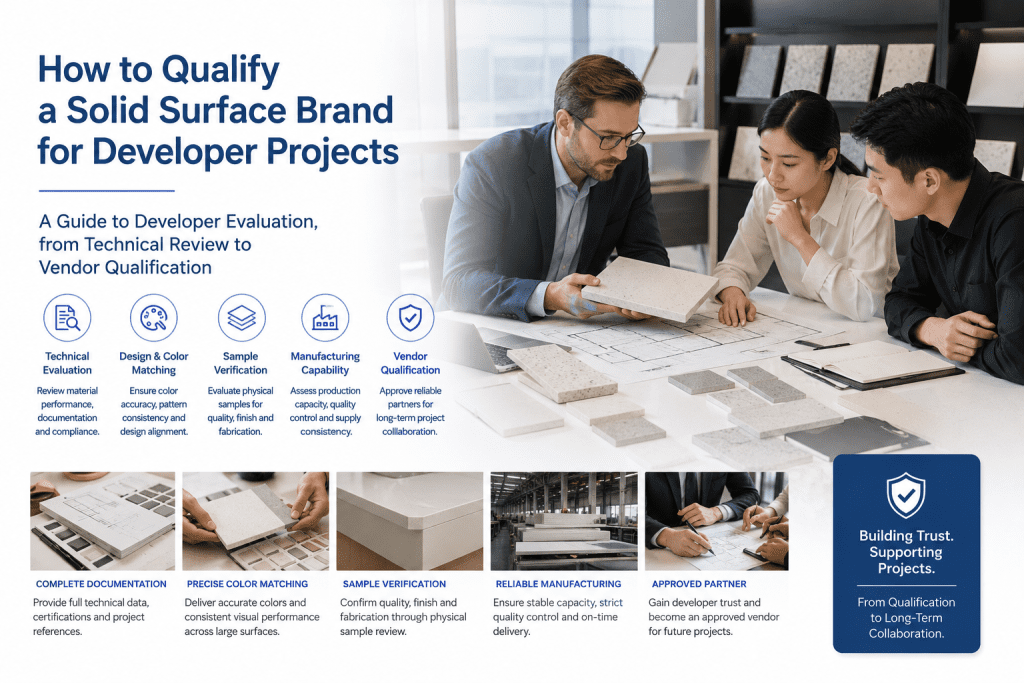
Selecting a solid surface material for a large architectural project involves far more than comparing colors and prices.
For developers, every material choice carries potential project risk. A mismatch in color, inconsistent product quality, delayed deliveries or insufficient technical support can affect construction schedules, project budgets and long-term building performance.
As a result, most developers follow a structured qualification process before approving a new solid surface brand for project specification.
Why Developers Follow a Qualification Process
Every material selected for a development project carries responsibility.
A material failure can lead to costly repairs, project delays, design compromises and reputational risk. For this reason, developers rarely approve a new material supplier based solely on samples or pricing.
Instead, they follow a qualification process designed to answer three fundamental questions:
- Can the material meet the project’s technical requirements?
- Can the supplier consistently support project delivery?
- Can the material remain reliable throughout the building’s lifecycle?
The qualification process helps developers reduce uncertainty before a material becomes part of a project specification.
What Developers Are Really Evaluating
Many suppliers assume developers are evaluating products. In reality, developers are evaluating risk.
Developers are not simply evaluating a product. They are evaluating whether the supplier can consistently support the project from design approval through fabrication, installation and future maintenance.
| What Suppliers Think | What Developers Actually Evaluate |
|---|---|
| Price | Project Risk |
| Sample Appearance | Long-Term Consistency |
| Production Capacity | Supply Reliability |
| Product Features | Project Performance |
| One Shipment | Multi-Year Support |
The Typical Solid Surface Qualification Process
Although approval procedures vary between organizations, most developer evaluations follow a similar framework.
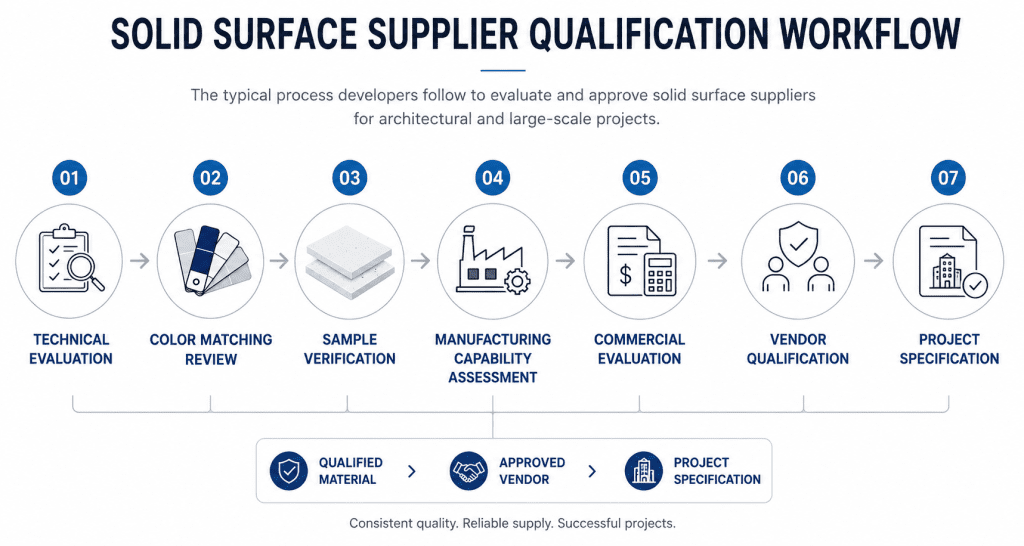
Step 1: Technical Evaluation
Before considering appearance, pricing or supply capability, developers first need to determine whether a solid surface material is technically suitable for the project.
Typical evaluation criteria include material composition, sheet dimensions, thickness options, thermoforming capability, seamless joining performance, repairability and suitability for commercial applications.
For healthcare facilities, hospitality environments, educational buildings and high-traffic public spaces, additional emphasis may be placed on hygiene, durability and long-term appearance retention.
Technical documentation plays an important role during this stage because it helps consultants and project teams determine whether a material can proceed to further review.
Common Qualification Documents
- Technical Data Sheet (TDS)
- Product Specifications
- Warranty Information
- Fire Test Reports
- Material Safety Documentation
- Project Reference Information
- Company Profile
Step 2: Design and Color Matching Review

For many architectural projects, design compatibility is just as important as technical performance.
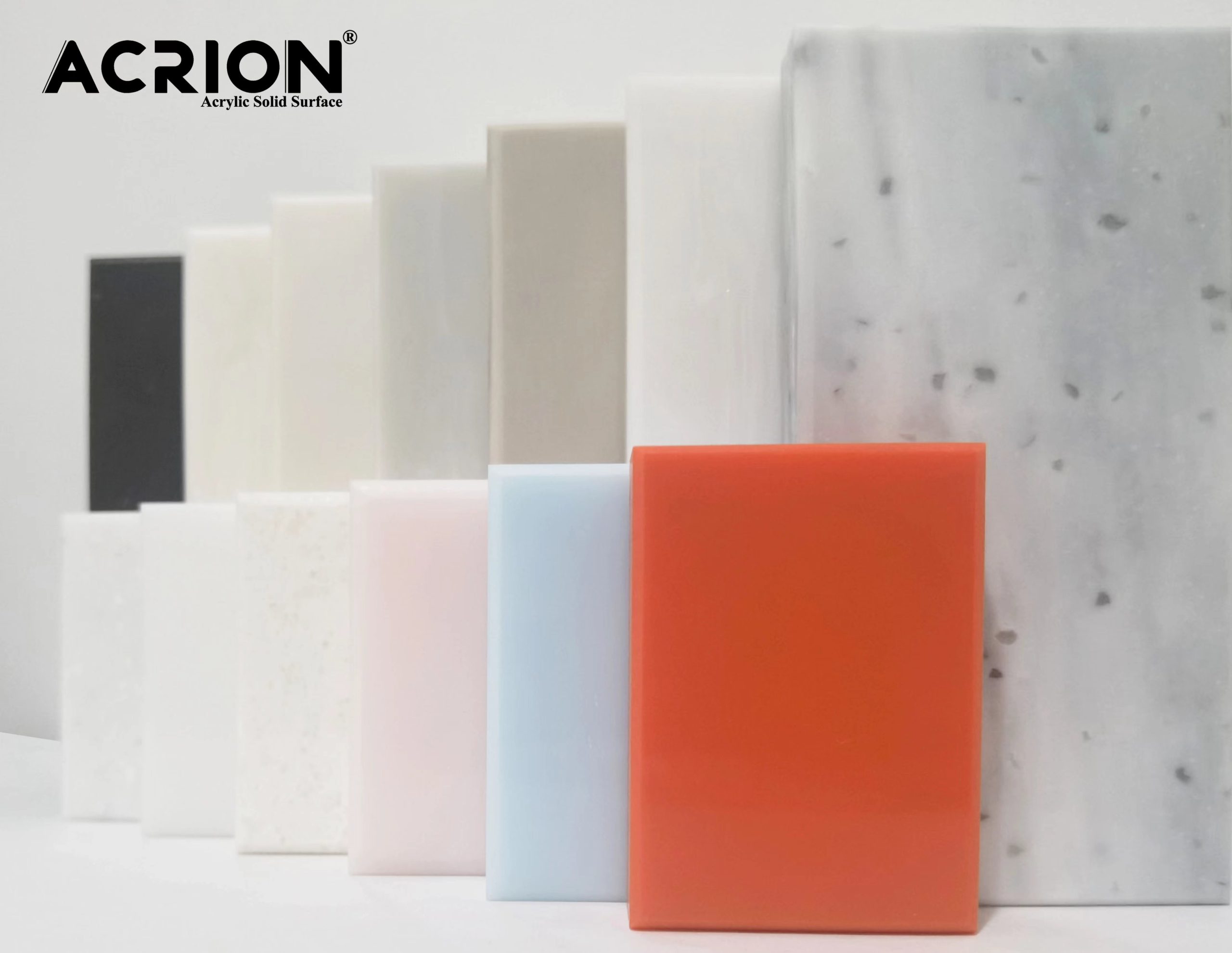
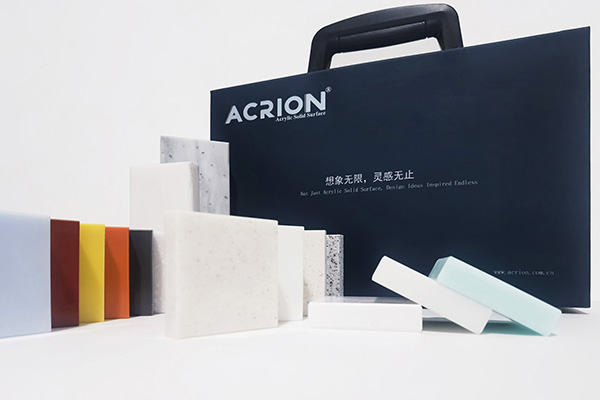
Developers and design teams commonly evaluate color accuracy, particle distribution, vein consistency, surface finish and overall visual appearance.
This stage becomes particularly important when a project already includes approved design concepts, showroom mock-ups or reference materials.
Why Color Approval Is Often More Difficult Than Expected
Color approval is not simply about matching a sample.
Developers and design teams are often evaluating how the material will perform across large installations, under different lighting conditions and alongside adjacent finishes.
Unlike many architectural materials, solid surface is frequently fabricated into large seamless applications. Reception counters, healthcare workstations, wall cladding systems and custom furniture often require multiple sheets to be joined together.
Even small variations that appear acceptable on a sample panel may become noticeable once the material is installed across large seamless surfaces.
For this reason, multiple rounds of sample development and refinement are common before final approval is achieved.
Step 3: Sample Verification
After technical and visual requirements have been reviewed, physical samples are typically submitted for evaluation.
Typical review items include surface quality, color consistency, edge finishing, fabrication workmanship, joint appearance and overall visual uniformity.
Depending on project requirements, architects, consultants, contractors, procurement teams and developers may all participate in sample evaluation.
The objective is not simply to approve a sample, but to reduce uncertainty before specification and procurement decisions are made.
Step 4: Manufacturing Capability Assessment

A successful sample does not automatically guarantee successful project execution.
Developers also need confidence that the supplier can maintain quality and consistency throughout the project lifecycle.
- Production capacity
- Quality control procedures
- Batch-to-batch consistency
- Lead times
- Logistics capability
- Export experience
For large developments, qualification is not limited to today’s order volume. Developers often consider future phases, repeat orders and expansion opportunities that may require the same material standard years later.
Step 5: Commercial Evaluation
Once technical and manufacturing requirements have been satisfied, developers typically conduct a commercial review.
Contrary to popular belief, this stage is rarely focused on unit price alone.
- Pricing structure
- Warranty coverage
- Delivery commitments
- Payment terms
- Supply reliability
- Long-term commercial stability
The goal is to establish confidence that the material can remain available and commercially viable throughout the duration of the project.
Step 6: Vendor Qualification and Approval

The final stage involves determining whether the material and supplier are suitable for inclusion within the developer’s approved vendor system.
At this point, the developer is effectively answering a simple question:
Would we be comfortable specifying this material and supplier for future projects?
If the answer is positive, the supplier may be added to an approved vendor pool or preferred supplier list.
Qualification should be viewed as a strategic milestone rather than a single sales event because it establishes credibility and reduces future barriers to project participation.
How Material Qualification Influences Project Specification
Successful qualification is often the first step toward project specification.
Once a material has completed technical, design and commercial review, architects and consultants may consider it for inclusion within project documentation.
- Architectural specifications
- Material schedules
- Tender documentation
- Approved vendor lists
- Design standards
For suppliers, specification represents a significant milestone because it increases the likelihood that the material will be considered during future procurement stages.
Projects Where Qualification Is Common
- Residential developments
- Hotels and hospitality projects
- Healthcare facilities
- Educational buildings
- Commercial offices
- Mixed-use developments
- Transportation infrastructure
The larger and more complex the project, the more rigorous the qualification process is likely to become.
Who Participates in the Approval Process?
- Architects – Design intent and aesthetics
- Consultants – Technical compliance and specifications
- Procurement Teams – Commercial and supply review
- Contractors – Fabrication and installation practicality
- Developers – Final project approval
Real-World Considerations During Qualification
While qualification procedures are often documented as structured workflows, real-world projects rarely move in a perfectly linear manner.
Design revisions, budget approvals, project schedule changes and procurement priorities can all influence qualification timelines.
As a result, some materials may complete technical approval quickly, while others remain under review for extended periods despite meeting project requirements.
Understanding these practical realities helps all stakeholders manage expectations throughout the qualification process.
Common Qualification Challenges
- Inconsistent Color Matching
- Incomplete Documentation
- Limited Supply Capacity
- Insufficient Technical Support
- Lack of Relevant Project References
Key Takeaway
Many suppliers focus on winning an order. Developers focus on reducing risk.
The suppliers most likely to be specified are usually the ones that help developers reduce uncertainty before the project begins.“
Frequently Asked Questions
How long does solid surface qualification typically take?
Depending on project complexity, qualification may take anywhere from several weeks to several months.
Does material approval automatically lead to project specification?
Not always. Many developers maintain approved material and supplier lists before selecting products for specific projects.
Can developers approve alternatives to specified brands?
Yes. Alternative materials may be considered if they satisfy technical, aesthetic and commercial requirements.
Why are multiple sample revisions often required?
Color perception, lighting conditions and design expectations frequently require several rounds of refinement before final approval.
What documents are usually requested during evaluation?
Technical data sheets, warranty information, test reports, product specifications and project references are commonly requested.
Conclusion
Successful qualification is rarely achieved through pricing alone.
Developers evaluate solid surface materials through a combination of technical review, design verification, manufacturing assessment and commercial evaluation.
The objective is not simply to identify a suitable product, but to identify a reliable long-term project partner.
For suppliers, architects and project stakeholders, understanding this process can significantly improve the likelihood of successful participation in future architectural developments.