Lors de l’évaluation d’une surface solide acrylique pour des projets architecturaux, une question technique apparaît fréquemment :
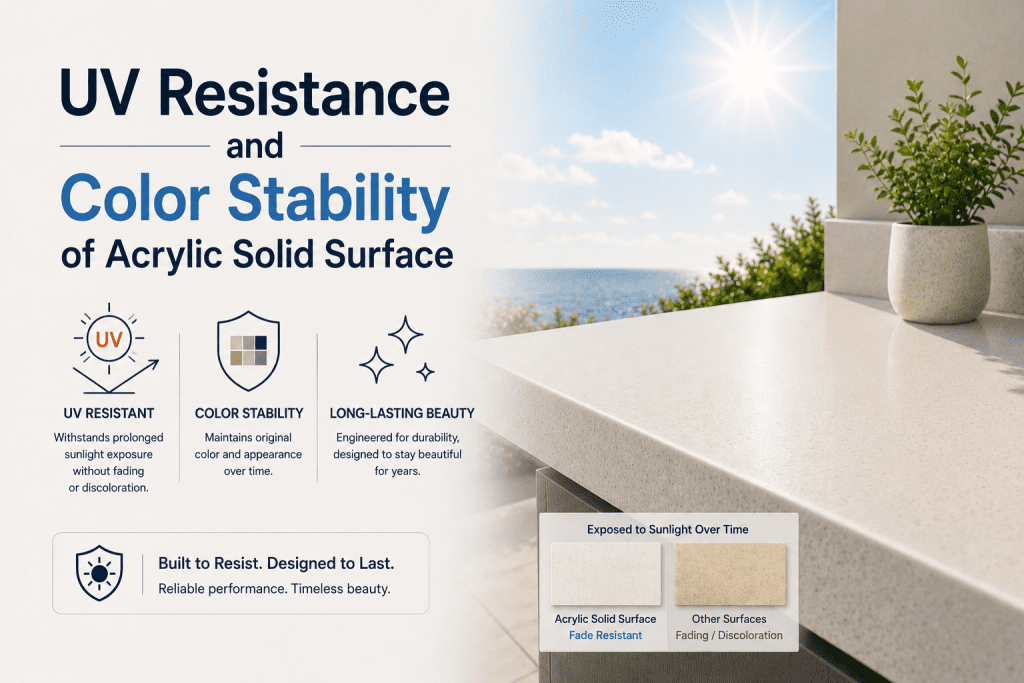
Comment la surface solide acrylique se comporte-t-elle sous l’exposition aux UV et à la lumière du soleil ?
Il s'agit d'une question importante car de nombreux environnements de projet ne sont pas des espaces intérieurs entièrement clos. Les zones de réception à proximité de murs-rideaux, les environnements d'accueil avec une forte lumière du jour, les façades de commerces, les intérieurs d'aéroports, les terminaux de transport et les installations semi-extérieures exposent tous les matériaux à différents niveaux de rayonnement ultraviolet.
La bonne réponse nécessite des nuances techniques.
La surface solide acrylique est connue pour sa forte stabilité visuelle à long terme, mais comme tout matériau à base de polymère, ses performances dépendent de la qualité de la formulation, de la conception de l'application et des conditions d'exposition.
Qu’est-ce que le rayonnement UV et pourquoi est-ce important ?
Le rayonnement ultraviolet fait partie de la lumière naturelle du soleil et transporte suffisamment d’énergie pour affecter progressivement de nombreux matériaux polymères au fil du temps.
L’exposition aux UV à long terme peut contribuer à :
- Vieillissement superficiel
- Changement de pigment
- Réduction de la brillance
- Dégradation des micro-surfaces
- Incohérence d'apparence
- Réduction des propriétés mécaniques dans les cas extrêmes
Les performances UV sont donc très importantes dans la spécification des matériaux architecturaux.
Comment l'acrylique (PMMA) se comporte sous exposition aux UV
Le PMMA (polyméthacrylate de méthyle), la chimie acrylique de base utilisée dans les surfaces solides acryliques pures, est généralement reconnu pour sa forte résistance aux UV et aux intempéries par rapport à de nombreux autres matériaux thermoplastiques.
C’est l’une des raisons pour lesquelles les matériaux acryliques sont largement utilisés dans des applications techniques exigeantes.
Cependant, une forte résistance aux UV ne signifie pas une immunité illimitée à l’exposition.
Les performances réelles dépendent de :
- Pureté de la résine
- Ingénierie des systèmes pigmentaires
- Formulation du matériau
- Cohérence de la fabrication des feuilles
- Famille de couleurs
- Accumulation de chaleur
- Intensité environnementale
La surface solide en acrylique se décolore-t-elle à la lumière du soleil ?
C’est la préoccupation la plus courante des acheteurs.
La réponse professionnelle est : La surface solide en acrylique de haute qualité offre une forte résistance au vieillissement visuel, mais les performances dépendent des conditions d'exposition.
Par exemple:
- Applications intérieures avec lumière du jour indirecte → stabilité généralement excellente
- Intérieurs commerciaux à proximité du vitrage → performances généralement fortes
- Environnements semi-extérieurs ombragés → évaluation au cas par cas
- Exposition directe à l'extérieur → précaution technique requise
Tous les scénarios « d’exposition au soleil » ne sont pas équivalents.
Exposition intérieure, semi-extérieure ou extérieure
Applications intérieures
Une utilisation architecturale intérieure typique présente un faible risque UV.
Les exemples incluent :
- Comptoirs d'accueil
- Plans de travail pour le secteur médical
- Systèmes de vanité
- Revêtement mural
- Luminaires de vente au détail
- Intérieurs d'hôtellerie
C’est dans ces applications que la surface solide acrylique fonctionne le mieux.
Applications semi-extérieures
Les conditions semi-extérieures nécessitent un jugement plus technique.
Exemples :
- Entrées couvertes
- Comptoirs d'accueil ombragés
- Terminaux de transport protégés
- Zones architecturales à proximité des façades ouvertes
L'adéquation dépend de l'intensité des UV, de l'accumulation de chaleur, de la ventilation et de la sélection des couleurs.
Exposition extérieure complète
L’exposition directe et continue aux UV en extérieur constitue un environnement fondamentalement différent.
L’évaluation des matériaux doit être basée sur des critères techniques spécifiques plutôt que sur des hypothèses générales de performances intérieures.
La couleur compte : toutes les nuances ne se comportent pas de la même manière
La sélection des couleurs peut influencer les performances d’apparence UV.
Les variables incluent :
- Chimie des pigments
- Nuances sombres ou claires
- Systèmes de particules décoratives
- Complexité du modèle
- Différences d'absorption de chaleur
Pour les applications critiques du projet, une évaluation spécifique des couleurs est recommandée.
Résistance aux UV vs stabilité globale des couleurs
La résistance aux UV n’est qu’un élément de la performance esthétique à long terme.
Pour des considérations plus larges sur la stabilité des couleurs, notamment la maintenance, le jaunissement et les performances d’apparence du cycle de vie, consultez notre guide principal.
Lire le guide de stabilité des couleurs
Recommandations de conception architecturale
Lors de la spécification d'une surface solide acrylique dans des environnements adjacents à la lumière du soleil, les professionnels doivent prendre en compte :
- Type de demande
- Orientation de l'exposition
- Durée d'ensoleillement
- Accumulation de chaleur
- Ventilation
- Sélection de couleurs
- Attentes du cycle de vie du projet
La spécification correcte des matériaux consiste à adapter les performances à l'environnement.
Pourquoi la surface solide acrylique reste un matériau architectural solide
Même lorsque les considérations UV s’appliquent, le solid surface acrylique reste très attractif car il combine :
- Fabrication sans couture
- Capacité de thermoformage
- Réparabilité
- Surfaces hygiéniques non poreuses
- Flexibilité de conception
- Forte performance architecturale intérieure
FAQ
La surface solide en acrylique est-elle résistante aux UV ?
Oui, la chimie acrylique offre une forte résistance aux UV par rapport à de nombreux systèmes polymères alternatifs, mais les performances réelles de l'application dépendent de la formulation et de l'environnement.
La surface solide acrylique peut-elle être utilisée à l’extérieur ?
L’adéquation de l’application dépend des conditions d’exposition, de la conception du projet et des attentes en matière de performances. Les scénarios intérieurs et semi-extérieurs diffèrent considérablement d’une exposition entièrement extérieure.
Les couleurs sombres absorbent-elles plus de chaleur ?
Dans les environnements de projet pratiques, les surfaces plus sombres peuvent subir une plus grande absorption de chaleur, ce qui peut influencer les considérations de performances à long terme.
Discutez de votre projet avec ACRION
ACRION soutient les architectes, les distributeurs, les fabricants et les acheteurs de projets avec des solutions architecturales de surfaces solides en acrylique et des conseils d'application technique.