When evaluating acrylic solid surface for architectural projects, one technical question appears frequently:
How does acrylic solid surface perform under UV exposure and sunlight?
This is an important question because many project environments are not fully enclosed interior spaces. Reception areas near curtain walls, hospitality environments with strong daylight, retail façades, airport interiors, transport terminals, and semi-outdoor installations all expose materials to varying levels of ultraviolet radiation.
The correct answer requires technical nuance.
Acrylic solid surface is known for strong long-term visual stability, but like any polymer-based material, performance depends on formulation quality, application design, and exposure conditions.
What Is UV Radiation and Why Does It Matter?
Ultraviolet radiation is part of natural sunlight and carries enough energy to gradually affect many polymer materials over time.
Long-term UV exposure can contribute to:
- Surface aging
- Pigment shift
- Gloss reduction
- Micro-surface degradation
- Appearance inconsistency
- Mechanical property reduction in extreme cases
UV performance is therefore highly relevant in architectural material specification.
How Acrylic (PMMA) Performs Under UV Exposure
PMMA (polymethyl methacrylate), the core acrylic chemistry used in pure acrylic solid surface, is generally recognized for strong UV and weather resistance compared with many other thermoplastic materials.
This is one reason acrylic materials are widely used in demanding engineered applications.
However, strong UV resistance does not mean unlimited exposure immunity.
Real-world performance depends on:
- Resin purity
- Pigment system engineering
- Material formulation
- Sheet manufacturing consistency
- Color family
- Heat accumulation
- Environmental intensity
Does Acrylic Solid Surface Fade in Sunlight?
This is the most common buyer concern.
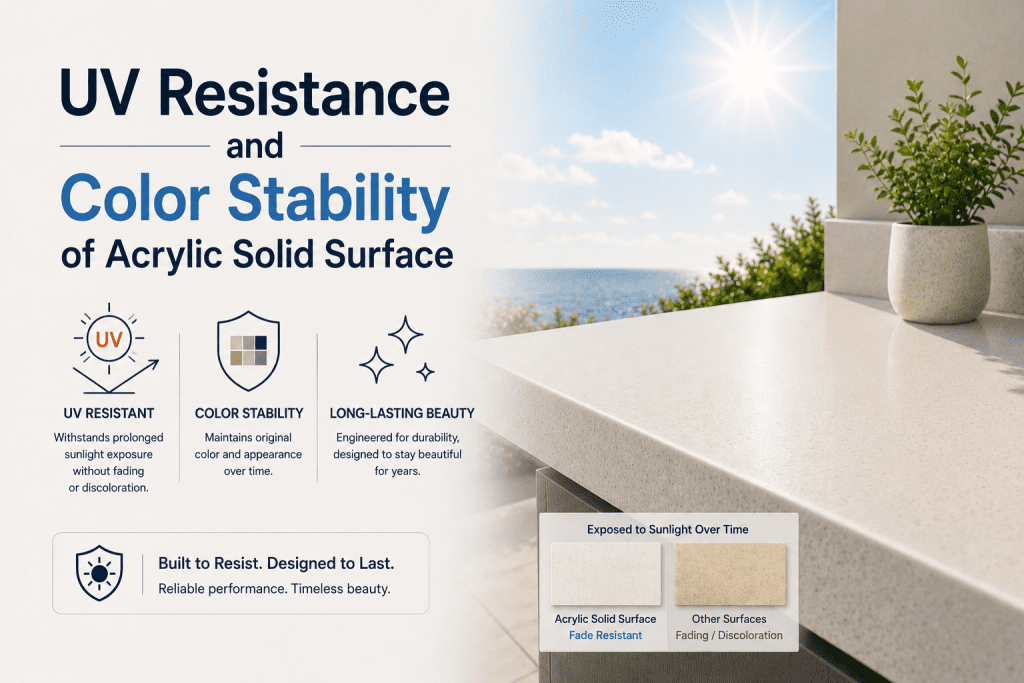
The professional answer is: high-quality acrylic solid surface offers strong resistance to visual aging, but performance depends on exposure conditions.
For example:
- Interior applications with indirect daylight → generally excellent stability
- Commercial interiors near glazing → typically strong performance
- Semi-outdoor shaded environments → case-by-case evaluation
- Direct full exterior exposure → engineering caution required
Not all “sunlight exposure” scenarios are equivalent.
Indoor vs Semi-Outdoor vs Exterior Exposure
Indoor Applications
Typical indoor architectural use presents low UV risk.
Examples include:
- Reception counters
- Healthcare worktops
- Vanity systems
- Wall cladding
- Retail fixtures
- Hospitality interiors
These applications are where acrylic solid surface performs best.
Semi-Outdoor Applications
Semi-outdoor conditions require more technical judgement.
Examples:
- Covered entrances
- Shaded hospitality counters
- Protected transport terminals
- Architectural feature zones near open façades
Suitability depends on UV intensity, heat build-up, ventilation, and color selection.
Full Exterior Exposure
Continuous direct outdoor UV exposure is a fundamentally different environment.
Material evaluation should be based on specific engineering criteria rather than general indoor performance assumptions.
Color Matters: Not All Shades Behave Identically
Color selection can influence UV appearance performance.
Variables include:
- Pigment chemistry
- Dark vs light shades
- Decorative particulate systems
- Pattern complexity
- Heat absorption differences
For project-critical applications, specific color evaluation is recommended.
UV Resistance vs Overall Color Stability
UV resistance is only one part of long-term appearance performance.
For broader color stability considerations including maintenance, yellowing, and lifecycle appearance performance, see our main guide.
Architectural Design Recommendations
When specifying acrylic solid surface in sunlight-adjacent environments, professionals should consider:
- Application type
- Exposure orientation
- Sunlight duration
- Heat accumulation
- Ventilation
- Color selection
- Project lifecycle expectations
Correct material specification is about matching performance to environment.
Why Acrylic Solid Surface Remains a Strong Architectural Material
Even when UV considerations apply, acrylic solid surface remains highly attractive because it combines:
- Seamless fabrication
- Thermoforming capability
- Repairability
- Hygienic non-porous surfaces
- Design flexibility
- Strong indoor architectural performance
FAQ
Is acrylic solid surface UV resistant?
Yes, acrylic chemistry offers strong UV resistance compared with many alternative polymer systems, but actual application performance depends on formulation and environment.
Can acrylic solid surface be used outdoors?
Application suitability depends on exposure conditions, project design, and performance expectations. Indoor and semi-outdoor scenarios differ significantly from full exterior exposure.
Do dark colors absorb more heat?
In practical project environments, darker surfaces may experience greater heat absorption, which can influence long-term performance considerations.
Discuss Your Project with ACRION
ACRION supports architects, distributors, fabricators, and project buyers with architectural acrylic solid surface solutions and technical application guidance.