Los proyectos arquitectónicos modernos utilizan cada vez más sistemas de materiales sin costuras en entornos interiores y exteriores protegidos. La superficie sólida acrílica a veces se incorpora en aplicaciones de paredes semi-exteriores debido a su capacidad de fabricación sin costuras, flexibilidad de termoformado y apariencia arquitectónica refinada.
Los ambientes de hospitalidad cubiertos, los espacios exteriores comerciales protegidos, las áreas de recepción con sombra y las instalaciones de elementos arquitectónicos se encuentran entre las aplicaciones semi-exteriores más comunes para los sistemas de paredes de superficie sólida acrílica.
Cuando se diseña e instala correctamente, la superficie sólida acrílica puede admitir ciertas aplicaciones arquitectónicas exteriores protegidas que priorizan la continuidad visual perfecta y el diseño de superficie integrado.
¿Se puede utilizar la superficie sólida acrílica en exteriores?
La superficie sólida acrílica se puede utilizar en entornos arquitectónicos semiexteriores y exteriores protegidos seleccionados según las condiciones del proyecto, la selección de materiales, el diseño de la instalación y los factores de exposición a largo plazo.
A diferencia de los sistemas de revestimiento de fachadas totalmente expuestas diseñados específicamente para la exposición a la intemperie exterior a gran escala, la superficie sólida acrílica se utiliza más comúnmente en aplicaciones arquitectónicas cubiertas o parcialmente protegidas donde se puede controlar mejor la exposición directa a los rayos UV y el estrés ambiental extremo.
La evaluación del proyecto siempre debe considerar la exposición a la luz solar, las condiciones climáticas, el movimiento térmico, los sistemas de soporte estructural y los requisitos de mantenimiento.
Aplicaciones exteriores cubiertas y semiexteriores
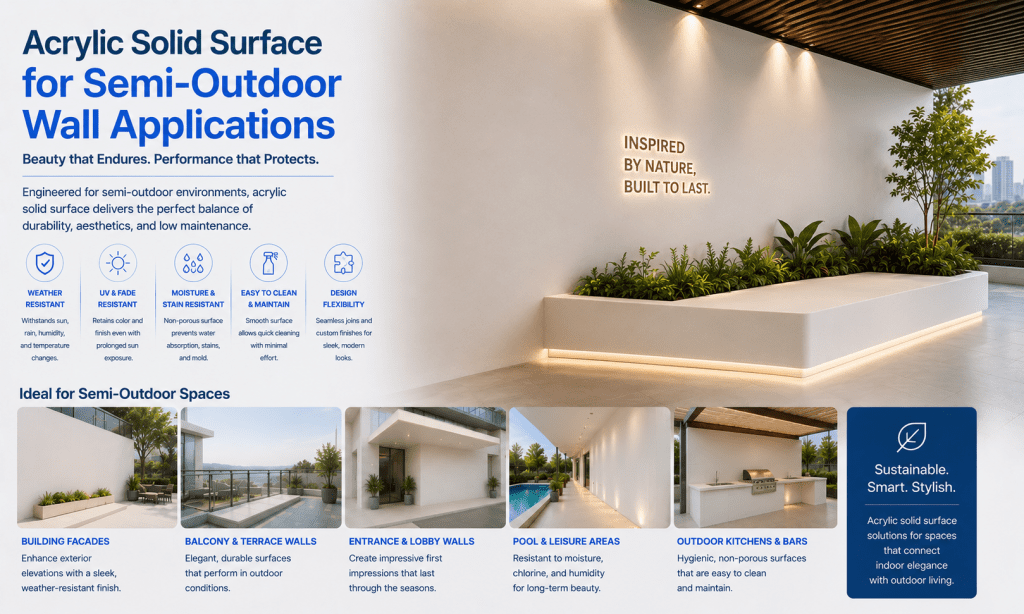
La superficie sólida acrílica se utiliza cada vez más en entornos comerciales y de hostelería semiexteriores que enfatizan la continuidad arquitectónica entre los espacios interiores y exteriores.
Las aplicaciones comunes semi-exteriores incluyen:
- Paredes de terraza cubiertas
- Paredes características de hospitalidad
- Áreas de recepción al aire libre
- Entradas comerciales protegidas
- Espacios de salón exteriores con sombra
- Fondos de bar al aire libre
- Estaciones de lavado semiexteriores
- Sistemas de paredes con marquesinas arquitectónicas
Estas aplicaciones suelen implicar entornos parcialmente protegidos con exposición ambiental directa reducida.
Sistemas de paredes exteriores
Las paredes arquitectónicas son una de las aplicaciones exteriores más adecuadas para superficies sólidas acrílicas en entornos protegidos.
Debido a que el material admite una fabricación perfecta, geometría curva y detalles personalizados, los diseñadores pueden crear sistemas de paredes esculturales e instalaciones arquitectónicas integradas para proyectos comerciales y hoteleros.
Los acabados de superficie mate y la continuidad visual perfecta también se alinean bien con las tendencias de diseño arquitectónico minimalista contemporáneo.
Exposición a los rayos UV y consideraciones climáticas
La exposición a los rayos UV y las condiciones climáticas a largo plazo son consideraciones importantes en aplicaciones arquitectónicas exteriores. Las diferentes formulaciones de superficies sólidas acrílicas pueden funcionar de manera diferente según la intensidad de la luz solar, las condiciones climáticas y la ubicación del proyecto.
Los materiales de superficie sólida de acrílico puro generalmente brindan un mejor rendimiento en exteriores a largo plazo en comparación con algunas formulaciones acrílicas modificadas en entornos con mayor exposición a los rayos UV.
Los diseñadores y fabricantes arquitectónicos deben evaluar cuidadosamente las condiciones ambientales antes de especificar materiales de superficie sólida para aplicaciones relacionadas con exteriores.
Sistemas de Instalación y Expansión Térmica
Los ambientes exteriores y semiexteriores experimentan una mayor variación de temperatura en comparación con los espacios interiores. Por lo tanto, se deben considerar la expansión térmica y el movimiento durante el diseño e instalación del sistema de pared.
Los sistemas de instalación profesionales pueden incluir márgenes de expansión, sistemas de soporte de subestructura, métodos de fijación mecánica y consideraciones de tamaño de panel apropiado según los requisitos del proyecto.
La planificación adecuada de la fabricación y la instalación ayuda a mantener la estabilidad de la superficie y la coherencia arquitectónica a largo plazo.
Aplicaciones exteriores comerciales y de hostelería
Los entornos hoteleros y comerciales utilizan cada vez más superficies sólidas acrílicas para elementos arquitectónicos exteriores protegidos que requieren una fabricación personalizada y una integración visual perfecta.
Los complejos turísticos, hoteles, áreas de descanso al aire libre, terrazas comerciales y espacios de hospitalidad semi-exteriores a menudo utilizan sistemas de pared destacados, mostradores integrados e instalaciones de superficie arquitectónica fabricadas con materiales acrílicos de superficie sólida.
Estos proyectos generalmente priorizan la continuidad arquitectónica entre los ambientes interiores y exteriores mientras mantienen condiciones de exposición controladas.
Por qué los diseñadores utilizan superficies sólidas acrílicas para aplicaciones exteriores protegidas
En comparación con muchos materiales decorativos tradicionales, la superficie sólida acrílica ofrece una mayor flexibilidad de fabricación para sistemas de paredes arquitectónicos personalizados.
El material se puede termoformar, unir sin problemas, procesar mediante CNC y fabricar en geometría curva, sistemas de iluminación integrados y superficies arquitectónicas escultóricas.
Esta flexibilidad permite a los arquitectos y fabricantes crear entornos arquitectónicos más integrados y visualmente continuos en espacios interiores y exteriores protegidos.
Preguntas frecuentes
¿Se puede utilizar una superficie sólida acrílica en exteriores?
La superficie sólida acrílica se puede utilizar en aplicaciones seleccionadas semiexteriores y exteriores protegidas según las condiciones ambientales, el tipo de material y el diseño de la instalación.
¿Qué aplicaciones exteriores son adecuadas para la superficie sólida acrílica?
Las paredes de terrazas cubiertas, las paredes de elementos de hospitalidad, las áreas de recepción al aire libre y las instalaciones comerciales protegidas se encuentran entre las aplicaciones semi-exteriores más comunes.
¿La exposición a los rayos UV afecta la superficie sólida acrílica?
La exposición prolongada a los rayos UV puede afectar la apariencia de la superficie según la formulación del material y las condiciones ambientales. Los materiales acrílicos puros generalmente proporcionan un mejor rendimiento en exteriores.
¿Se puede termoformar una superficie sólida acrílica para paredes exteriores?
Sí. La superficie sólida acrílica se puede termoformar en geometría curva y formas arquitectónicas personalizadas para aplicaciones exteriores protegidas.
¿Qué se debe tener en cuenta al instalar una superficie sólida en exteriores?
Las consideraciones importantes incluyen la exposición a los rayos UV, la expansión térmica, los sistemas de instalación, el soporte de la subestructura, las condiciones climáticas y los requisitos de mantenimiento a largo plazo.
Conclusión
La superficie sólida acrílica puede soportar aplicaciones seleccionadas de paredes exteriores protegidas y semiexteriores que requieren una continuidad arquitectónica perfecta, flexibilidad de fabricación personalizada y una apariencia refinada del material.
Desde paredes destacadas para hostelería y ambientes de terrazas cubiertas hasta instalaciones comerciales protegidas, la superficie sólida acrílica continúa brindando soluciones de superficies arquitectónicas para proyectos que priorizan el diseño espacial integrado y sistemas de materiales sin costuras.